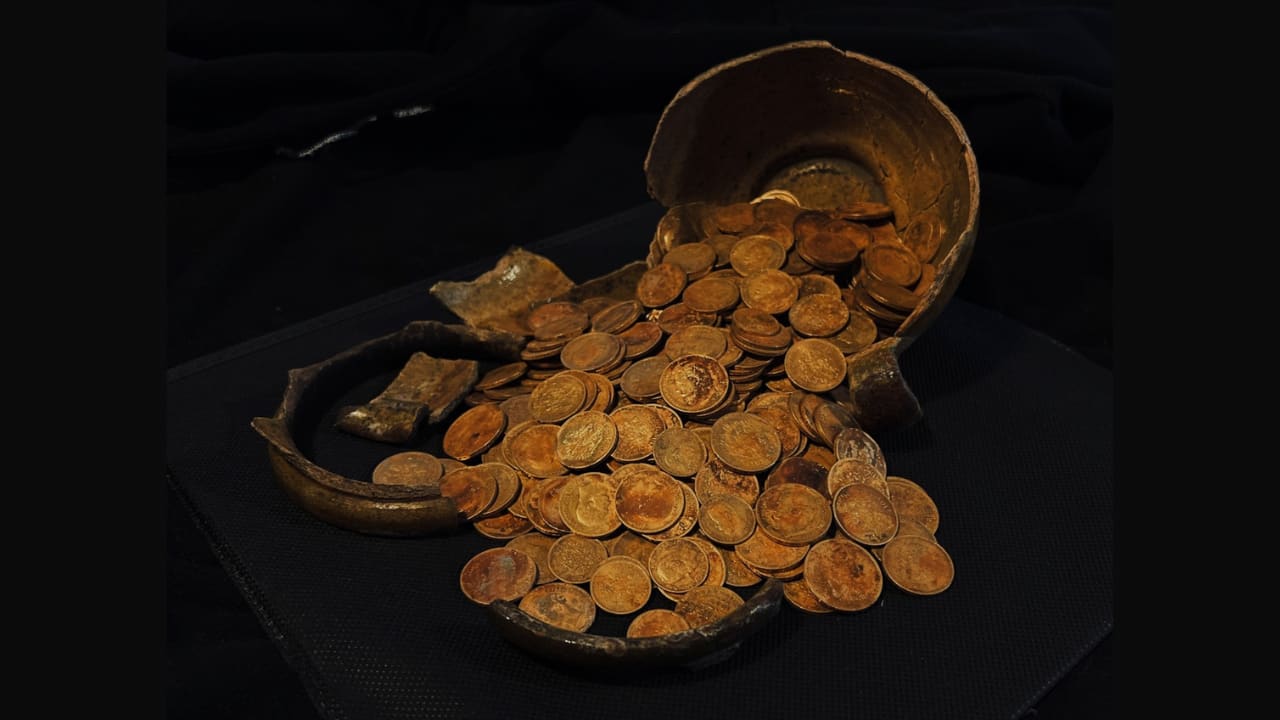
A hoard of 409 gold ruble coins dated to over a century ago was discovered underneath a home in Torzhok, Russia, the Institute of Archaeology of the Russian Academy of Sciences shared in early March.
Discovered during a joint expedition between the Institute and the All-Russian Historical and Ethnographic Museum in 2025, the hoard is one of the largest hoards of late Imperial Russian gold coins ever to be recovered.
Part of the property under excavation contained the foundations of a house believed to have been destroyed during World War II. After the war, the home’s new owners rebuilt the wooden house on the surviving stone foundations.
Found hidden within a broken kandyushka (glazed clay vessel) in a pit under the house’s foundation, the hoard consisted of 387 gold 10-ruble coins, 10 five ruble coins, 10 coins worth 15 rubles, and two seven-and-a-half ruble coins were found.
Together, the coins add up to about 4,070 rubles, according to the Institute’s statement. Based on the melt value of one pre-revolution 10 ruble coin, which is about 90% gold, the entire hoard may be valued at an estimated half a million dollars.

The earliest coin, a five ruble piece from the reign of Nicholas I, was minted in 1848, and a second five-ruble coin bears dates back to the reign of Alexander III.
The remaining coins are from the reign of Nicholas II, the last tsar of Russia and father of the famed Anastasia, between 1894 and 1911.
One of the most intriguing finds, however, are the 15 and seven-and-a-half ruble denomination, as they were special-issue coins minted only in 1897, as part of the monetary reform introduced by then finance minister Sergei Witte that put Russia on the gold standard.
Coins belong to a ‘return hoard’
According to the Institute, the discovery has been classified as a “return hoard,” meaning that it had deliberately been concealed by an individual with the intention of recovery at a later date.
Even though the most recent coin found is dated to 1911, archaeologists believe the circumstances of the hoard’s concealment point strongly to the Russian Revolution, when private wealth was nationalized and holding gold became dangerous.
Historical records show that pre-1917, the street housed 24 different properties, including priests from the nearby Church of St. Demetrius, two merchants, a treasurer, a bookkeeper, an overseer, a tailor, a metalworker, a shoemaker, a court official, a secretary, and an unskilled labourer.
These records, however, do not correspond to modern addresses, leaving the precise property, and therefore the precise owner of the hoard, difficult to identify.
While researchers attempt to locate the owner of the coins, the hoard will be transferred to the All-Russian Historical and Ethnographic Museum in Torzhok, where it will eventually go on public display.