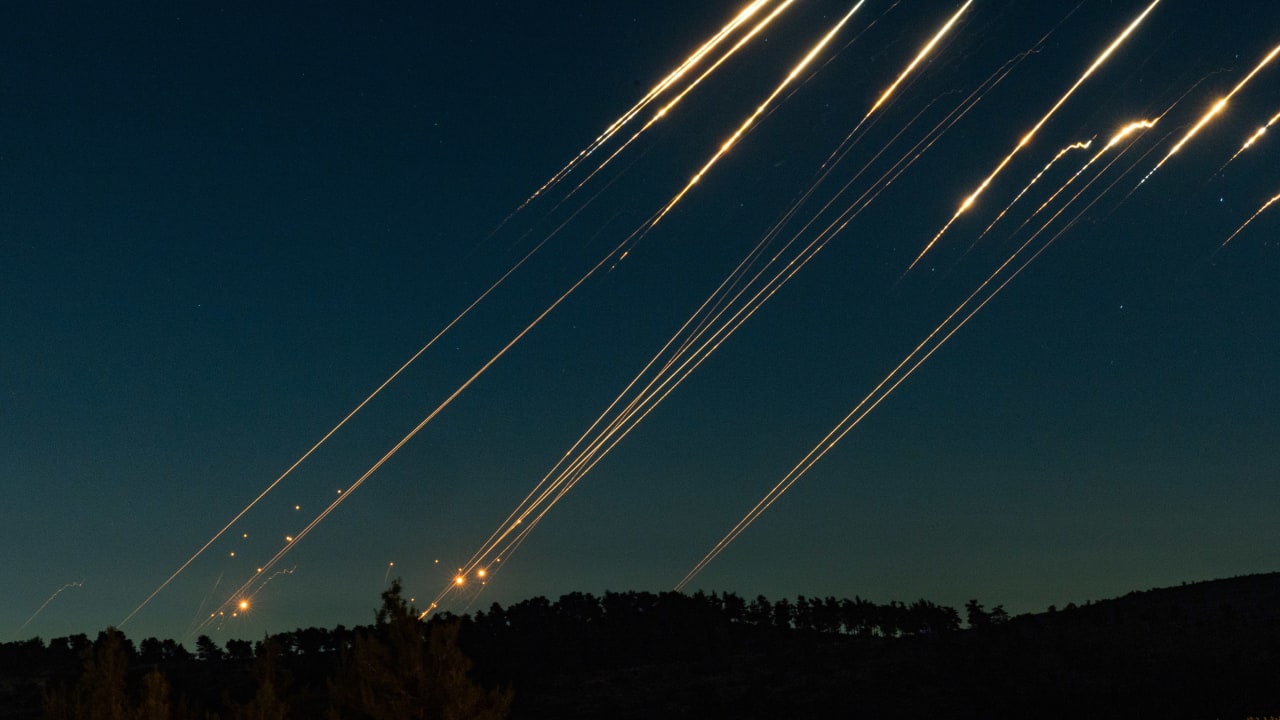
Operation Rising Lion caught me when I was abroad. As my rescue flight descended toward Israel through a tense and uncertain sky, I looked out the window and saw a flash of light in the distance – our defense systems intercepting an Iranian missile high above.
I was returning home while the country was under fire. In that surreal moment, I realized I was witnessing something extraordinary: not just a nation under attack, but a nation that had mastered the art of defending itself in the skies.
That moment captured the essence of Israel’s evolving defense doctrine: proactive, intelligent, and multi-layered. Behind it stands the Israel Missile Defense Organization (IMDO) – a key pillar within the Defense Ministry's Directorate of Defense Research and Development (DDR&D).
Since the October 7 attacks, through the historic Iranian attacks in April and October 2024, to the Israel-Iran War, the Ministry’s IMDO has become a strategic anchor not only for Israel, but also for regional stability.

<br><strong>Defending the homeland: IMDO’s war room</strong>
IMDO is responsible for the research, development, and operational integration of Israel’s missile defense systems. But more than that, it is the strategic brain behind the country’s aerial defense efforts – synchronizing industry, military, and intelligence in real time.
This synchronization includes close collaboration with the Israeli Air Force and the country’s leading defense industries. Before the war, Israel and the United States also carried out joint preparation drills, strengthening cooperation during the actual conflict.

During the Israel-Iran War, IMDO’s systems protected the home front from tens of thousands of rockets, UAVs, and missiles launched from Gaza, Lebanon, and other fronts. But it was on April 13, 2024, and again on October 1, 2024, that these systems faced a new major challenge: full-scale, multi-axis Iranian attacks involving hundreds of threats, including ballistic missiles, cruise missiles, and UAVs.
In June 2025, during Operation Rising Lion, Israel faced another wave of sustained Iranian aggression, with advanced and adaptive aerial threats launched over multiple days. Thanks to years of preparation, joint drills, and constant innovation, nearly all threats were successfully intercepted.
Three Layers, One Shield
At the heart of Israel’s defense is a multi-tiered missile defense network, designed to handle threats at different altitudes and distances.
The Iron Dome is designed to counter short-range rockets and mortars, and is a household name in Israel. During the war, it protected towns, cities, and vital infrastructure across the country.
David’s Sling was developed to fill the mid-range gap. It intercepts cruise missiles and longer-range threats, and its speed and accuracy make it a vital component against threats coming from beyond Israel’s borders.
The Arrow system (Arrow 2 and 3), was developed in close partnership with the United States. It is Israel’s exo-atmospheric shield, meaning it can intercept ballistic missiles outside Earth’s atmosphere. Arrow-4, currently under development as the next generation of the Arrow-2 interceptor, will have advanced capabilities.
This successful demonstration of Israel’s full missile defense network was not only a national achievement – it was a global milestone in aerial warfare.
The New Frontline: What Comes Next
Operation Rising Lion underscored that future wars may begin – and be decided – in the skies. The threats of tomorrow are already here. Missiles travelling faster than the speed of sound, swarming UAVs with autonomous coordination capabilities, and cyber-kinetic attacks, combining digital and physical disruption, are just a few of the threats the Jewish State faces from abroad.
To meet these, the Defense Ministry is already investing in next-generation systems, including laser-based interception technologies like Iron Beam, which has already demonstrated operational success with prototypes of smaller-scale high-power laser systems performing dozens of operational interceptions during the current war.
AI-enhanced early detection systems and modular mobile defense platforms are also being developed to improve adaptation to rapidly changing scenarios.
A strategic asset for the world
In recent years, Israel’s missile defense capabilities have become a global security asset. In 2020, the US Army acquired two Iron Dome batteries, a historic first. Today, Israel and the United States conduct regular joint exercises, co-develop systems like the Arrow, and coordinate on real-time defense operations.
In 2023, Israel signed a landmark $3.5 billion deal to sell the Arrow-3 system to Germany – the largest defense export in its history. David’s Sling was also sold to Finland, further demonstrating the global demand for Israel’s layered missile defense solutions. Now, these systems are gaining attention from other allied nations seeking protection from the same evolving threats.
Final thoughts: Trust in the sky
During Operation Rising Lion, Israel’s air defense proved itself a guardian of national resilience. As I watched the missiles intercepted in the sky above me, I trusted not just the technology but also the brilliance and readiness of the people behind it: engineers, soldiers, and leaders.
Today, the battlefield may be in the sky, but so is our future. And Israel is ready.