
An Iranian strike that wounded US troops at Prince Sultan Air Base in Saudi Arabia also damaged multiple aircraft and likely completely destroyed an E-3 Sentry aircraft. The attack some 60 miles south of the capital of Riyadh in the early hours of March 27 is said to have involved a coordinated precision barrage of at least one Iranian ballistic missile and several attack drones.
According to reports, some 10 to 12 American service members were injured in the attack, with at least two in serious condition. The base, a major operating location for US Air Force platforms during the war, has been attacked several times since the beginning of Operation Epic Fury/Operation Roaring Lion. Earlier in the week, 14 others were wounded in an attack, and another missile strike on the base on March 1 killed one service member.
The strike on Friday hit an installation housing troops and also caused significant damage to US KC-135 Stratotanker refueling aircraft that are essential for sustaining long-range US and Israeli air operations, along with the E-3 Sentry AWACS, one of the most important command-and-control platforms in the US inventory.
The attack left a clear trail of destruction across the installation, seen in satellite images and photos shared across social media. At least two photos showed the rear fuselage of one E-3 burnt, and the radar dome destroyed on the tarmac next to the plane.
The loss of an E-3 Sentry AWACS carries strategic consequences far beyond the physical destruction of a single airframe, as it degrades the ability to detect incoming hostile threats and coordinate any retaliatory response.
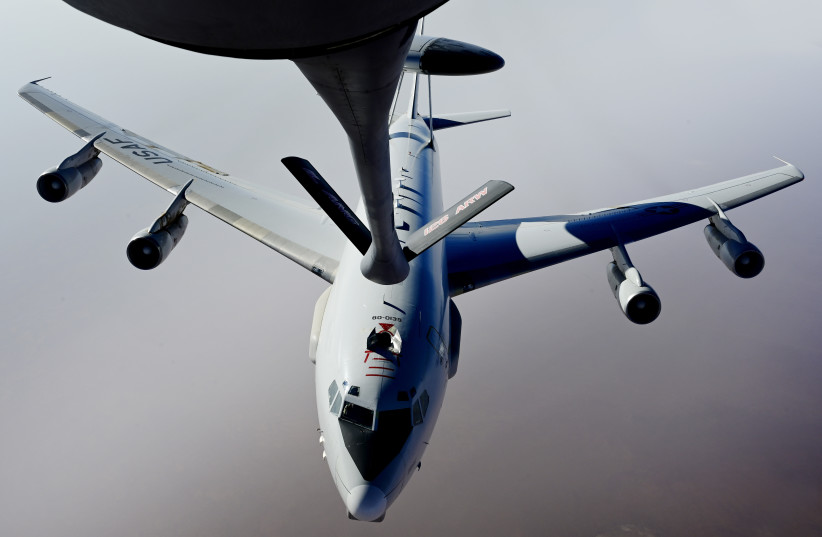
What is the E‑3 Sentry?
The E-3 Sentry is an Airborne Warning and Control System-modified Boeing 707 aircraft, instantly recognizable by the large rotating radar dome mounted above its fuselage. Its radar provides 360-degree surveillance across a 250-mile radius, allowing it to detect aircraft, drones, and missile launches while simultaneously coordinating friendly forces.
It’s been extensively used in military operations since the 1970s, including Operation Desert Storm, Kosovo, and the wars in Iraq and Afghanistan, as well as during Operation Inherent Resolve against the Islamic State.
The US Air Force had around 30 E-3 Sentry aircraft, with Boeing having delivered the last one in 1992. But as the platform struggles to maintain readiness, the USAF has cut the fleet almost in half to 16 aircraft. Of those, six were sent to the Middle East ahead of the war.
While the platform is nearing the end of its lifetime, it continues to serve as an airborne command post, linking fighters, bombers, and ground commanders into a unified operational picture throughout the region during the war.
Operation Epic Fury has involved thousands of US and Israeli sorties across Iran and the wider region. Managing such a vast air campaign requires persistent airborne command and control, and the E-3 Sentry has been central to that effort. Its ability to track threats, direct aircraft, and maintain situational awareness makes it the backbone of coordinated air operations.
Losing an E-3 during an ongoing high-tempo campaign reduces the coalition’s ability to manage airspace, respond to Iranian missile launches, and synchronize complex strike packages.
“The loss of this E-3 is incredibly problematic, given how crucial these battle managers are to everything from airspace deconfliction, aircraft deconfliction, targeting, and providing other lethal effects that the entire force needs for the battle space,” Heather Penney, a former F-16 pilot and director of studies and research at the Air & Space Forces Association’s Mitchell Institute for Aerospace Studies, told Air and Space Forces Magazine.
“The value of the E-3 and the battle managers is they see the big picture,” she said. “They’re the chessmaster, while [fighter pilots] are the bishops.”
Evidence of advanced Iranian targeting
Iran did not simply hit the base; it struck specific high-value aircraft, including refueling tankers and the AWACS.
Iran is said to be receiving external intelligence support from allies like China and Russia for advanced surveillance capabilities to target key installations across the Gulf. The attack’s accuracy suggests that Iran had access to timely, high-quality intelligence about aircraft positions and operational patterns at Prince Sultan Air Base, which also houses F-15E Strike Eagles, F-35A Lightnings, F-16 Fighting Falcons, and more.
The attack on Prince Sultan Air Base marks a moment when the war’s underlying dynamics became impossible to ignore.
Iran demonstrated not only the reach of its missile and drone arsenal but also an ability to identify and strike the very platforms that are making large-scale US air operations against the Islamic Republic possible.