
The wreck of the ship Altalena has been located intact on the Mediterranean seabed 78 years after its sinking, National Security Minister Itamar Ben-Gvir and the Heritage Ministry announced on Monday.
The Heritage Ministry said the ship was found at a depth of 503 meters, some 20 kilometers off Israel’s coast.
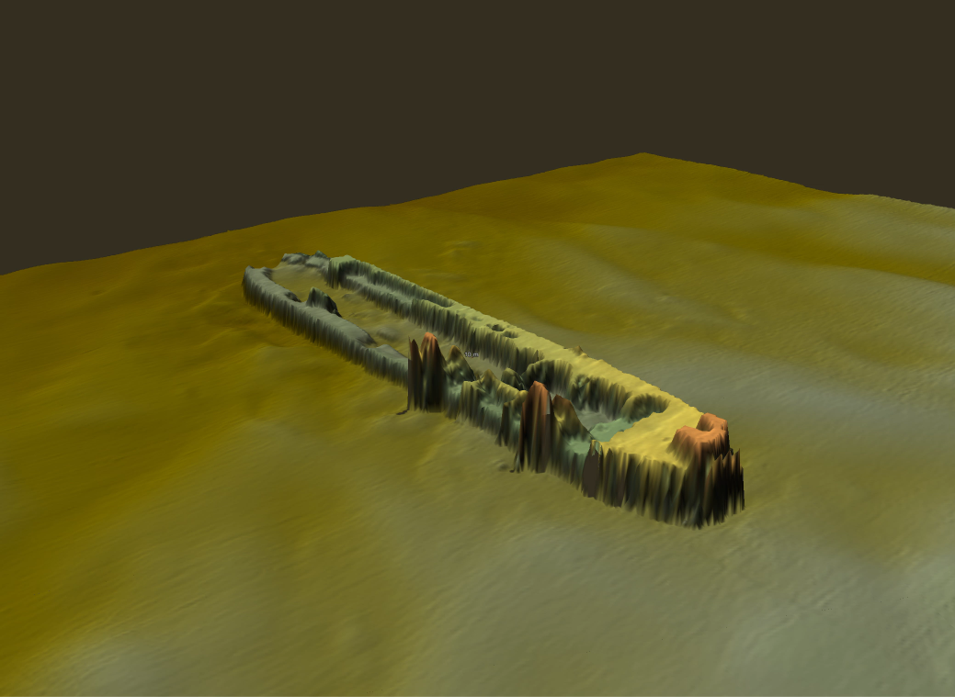
The discovery revives one of the most contentious episodes in Israel’s early history, when the newly established IDF and the Irgun came close to wider internecine fighting only weeks after independence.
The Altalena arrived off the Israeli coast in June 1948, carrying hundreds of immigrants to the new Jewish state, as well as Irgun fighters and a large shipment of weapons and ammunition intended for use in the War of Independence.
The Irgun, also known as Etzel, was a pre-state Jewish underground organization led by Menachem Begin that had fought British rule and Arab forces before Israel’s establishment as a modern state.

Following the State of Israel’s declaration of independence on May 14, 1948, the country’s separate Jewish armed organizations began to be incorporated into the newly established IDF. An agreement to integrate the Irgun into the IDF was signed on June 1, although Irgun forces in Jerusalem remained independent at the time.
The arrival of the Altalena posed a fundamental question to the fledgling government over the authority of the new state and its military.
The dispute between the two military wings centered on the weapons transported aboard the ship. Begin sought to allocate 20% of the arms to Irgun forces fighting in Jerusalem, while the remainder was to go to the IDF with Begin seeking to equip former Irgun units that had recently joined the military.
Prime minister David Ben-Gurion’s government insisted that weapons brought into the country ultimately came under IDF authority, amid fears that allowing separate political movements to maintain their own armed forces could create an “army within an army.”
The ship arrived during the first United Nations-brokered truce of the War of Independence, which prohibited the introduction of arms and fighting personnel.
From Kfar Vitkin to Tel Aviv
The Altalena reached Kfar Vitkin, north of Netanya, on June 20, where passengers disembarked, and weapons began to be unloaded.
The following day, IDF troops from the Alexandroni Brigade surrounded the area and ordered Begin to hand over the weapons. When the ultimatum was not accepted, fighting broke out between the IDF and Irgun forces.
Six Irgun members and two IDF soldiers were killed in the fighting at Kfar Vitkin before a ceasefire was reached and weapons that had already been brought ashore were handed over to the IDF.
Begin then boarded the Altalena, which sailed south toward Tel Aviv.
On June 22, the confrontation resumed off the Tel Aviv coast, with Begin himself aboard the ship. IDF soldiers eventually opened artillery fire on the Altalena, setting it ablaze and forcing those aboard to abandon the vessel.
Ten more Irgun members and one IDF soldier were killed in the Tel Aviv fighting, bringing the death toll from the affair to 19: three IDF soldiers and 16 Irgun members.
As the confrontation threatened to spiral further, Begin ordered the Irgun not to retaliate against the IDF and warned against allowing the dispute to descend into civil war. His decision became one of the defining elements of the Altalena affair and the future prime minister’s subsequent political legacy.
The burned-out vessel remained off the Tel Aviv coast before eventually being towed out to sea and sunk.
The affair left a deep scar on Israeli politics, becoming a defining episode in the rivalry between Ben-Gurion’s Labor Zionist movement and Begin’s Revisionist camp, while also establishing the principle that the newly formed state would maintain a single national military under government authority.

Discovery of Altalena is 'defining moment,' Heritage Minister says
“Tonight we are closing a historical circle on one of the most painful and formative events in the history of Israeli society,” Ben-Gvir said late on Sunday when the discovery was made.
“We have been dealing with this issue secretly for many years, and today the fruits of the intelligence and operational effort have borne exciting fruit for the sake of historical truth, the memory of the fallen, and unity with Israel.”
“The discovery of the Altalena is a defining moment for our national memory,” Heritage Minister Amichai Eliyahu stated. “We worked on this operation out of a deep-seated mission to reveal the historical truth and make the story of the ship’s heroes accessible to future generations.”
“The Altalena represented the peak of a severe internal confrontation,” Ramon Ziv-Av, deputy director-general of activities at the Ben-Gurion Heritage Institute, said. “Ben-Gurion viewed this test as a threat no less serious than the dangers that came from outside: the danger of an armed force operating outside the authority of the state.”
“The Altalena affair did not end with the sinking of the ship, and its discovery in the depths provides another opportunity to hold an important discussion that remains relevant today,” he added. “If, together with the ship, the danger of civil war also returns, it would be better for that danger to remain at sea.”