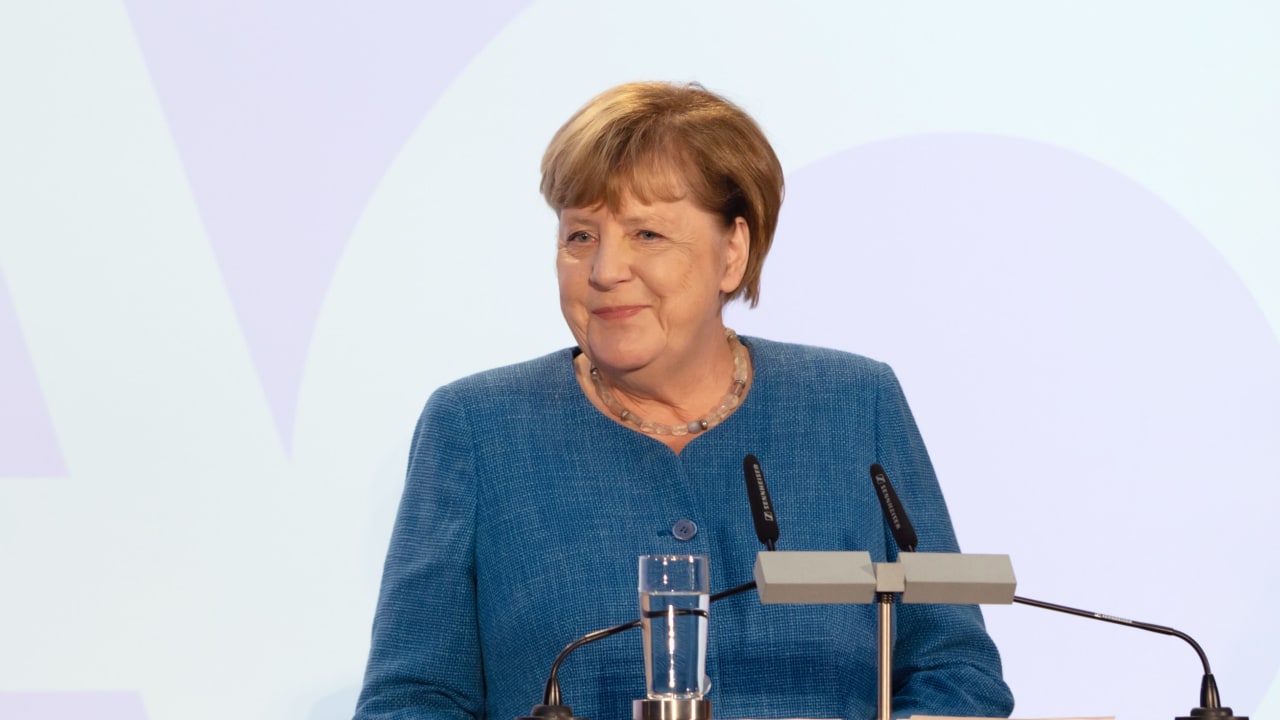
Former German Chancellor Angela Merkel defended Israel's right to exist and Germany's commitment to its security, reaffirming that the Jewish state's existence is part of Germany's Staatsräson, or fundamental national interest, during an appearance on the KAFFEE UND FLUCHEN podcast published on YouTube on Friday.
Addressing the war in Gaza amid rising antisemitism in Germany, Merkel reaffirmed the historical responsibility underpinning Berlin's relationship with Israel and its commitment to the Jewish state's security and continued existence.
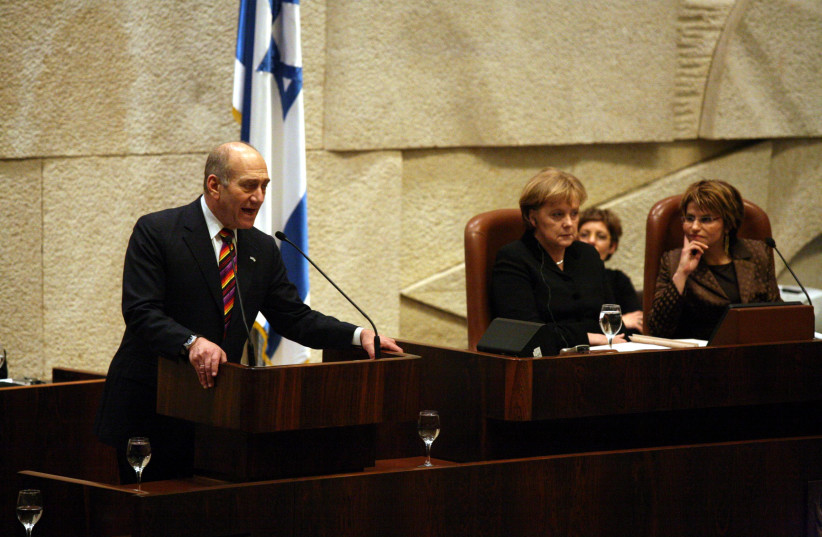
“I did indeed say in the Knesset at the time that, for me, Israel's right to exist is also part of Germany's Staatsräson,” Merkel said, referring to the German concept of raison d'état, or a fundamental national interest.
Merkel clarified, however, that Germany's commitment to Israel should not be interpreted as unconditional support for its government, or as a restriction on criticism of Prime Minister Benjamin Netanyahu and his policies, pointing to her own record on the matter.
“That is sometimes misinterpreted as meaning that, for example, one is not allowed to criticize Netanyahu's government,” Merkel said. "I did that many times as chancellor, and there are certainly reasons to do so now regarding the conduct in the Gaza Strip. So criticism is not prohibited at all.”
Merkel: Criticism of Israel must acknowledge threats to its existence
She stressed, however, that such criticism must take Israel's security and continued existence into account.
“But I must always keep in mind how I can help ensure that the State of Israel continues to exist, and preferably that it can also live in peace,” she said.
“And if you take that seriously, and I believe you have to take it seriously, then there are certain one-sided declarations that I simply cannot understand, and I reject them."
She also criticized Berlin's Left Party over its stance on Israel, pointing to the ongoing public debate and warning that threats to Israel's existence from Iran, Hamas, and other actors are real rather than merely theoretical.
“And October 7 was not an attack by Israel on the Gaza Strip. It was an attack by Hamas on Israel,” Merkel said.
She recalled Israel's withdrawal from the Gaza Strip in 2005, the year she became chancellor, and Hamas's subsequent takeover of the territory. She argued that Hamas's stated objective of destroying Israel was demonstrated by the October 7 attacks.
“And on October 7, they demonstrated that this is not merely a theoretical proposition. That has to be kept in mind if we want to have a reasonable discussion.”
Merkel highlights challenges of fighting Hamas in civilian areas
Merkel then addressed the difficult decisions facing Netanyahu and Israel's security establishment following the October 7 attacks, acknowledging that she had “never had to solve a task that difficult.”
“When there is a bunker beneath every kindergarten and beneath every hospital, and Hamas is sitting there, knowing that I can only destroy its position if I simultaneously attack what is above it, then the task becomes at least somewhat more complicated,” Merkel said.
“Because an Israeli prime minister must do everything possible to provide security for his citizens. That's what our citizens here in Germany also expect from those governing them," she said. "He must be able to promise his citizens security, or at least the greatest possible degree of security. Otherwise, you won't get elected.”
Nevertheless, Merkel argued that Israel's military response has, in some respects, gone too far, particularly regarding the humanitarian situation in Gaza.
“And nevertheless, you can and must identify and speak openly about instances of disproportionality in what the civilian population is being forced to endure. Especially when it comes to food supplies and other matters.”
Merkel also expressed surprise at what she described as the limited public criticism of Hamas from within Gaza.
“What surprises me, on the other hand, is that we've heard very, very few people from the Gaza Strip speaking critically about Hamas. And I think that, particularly after an attack like October 7…”
The podcast host interjected, “Because it's naturally also very dangerous for the people living there.”
“That’s true,” Merkel acknowledged.
Merkel questions disproportionate focus on Israel amid global humanitarian crises
She went on to argue that discussions about Gaza should recognize the circumstances surrounding Israel's military operations, suggesting that acknowledging this context could contribute to a more nuanced debate. At the same time, she reiterated that criticism of Israel remains legitimate and that some aspects of its conduct have been disproportionate.
Merkel also questioned the amount of international attention devoted to Israel compared with other humanitarian crises, particularly those in Yemen and Sudan, where civilian populations are experiencing widespread suffering.
“But if you look at how much is said about Yemen, where millions of children are starving, how much is said about Sudan, and how much is said about Israel, then there is also a certain disproportionality in the fact that virtually no discussion takes place about other situations.”