The International Court of Justice (ICJ) concluded on Thursday that there is a “reasonable” inference that Myanmar security forces acted with “genocidal intent” and violated the 1948 Genocide Convention.
“The court concludes that all the evidence before it, taken together, supports a reasonable inference that Myanmar security forces acted with genocidal intent,” ICJ Judge Iwasawa Yuji ruled in The Hague.
During a 2017 military crackdown, 10,000 Rohingya Muslims were killed, and hundreds of thousands were expelled to neighboring Bangladesh.
Two years later, on November 11, 2019, The Gambia filed a case at the ICJ accusing Myanmar of violating the 1948 Genocide Convention against the Rohingya population.
Myanmar has consistently rejected genocide accusations and argued that its forces were acting in response to attacks by armed militia. However, the ICJ ruled that Myanmar’s security forces committed genocide against its Rohingya minority Muslim population as well as widespread sexual violence.
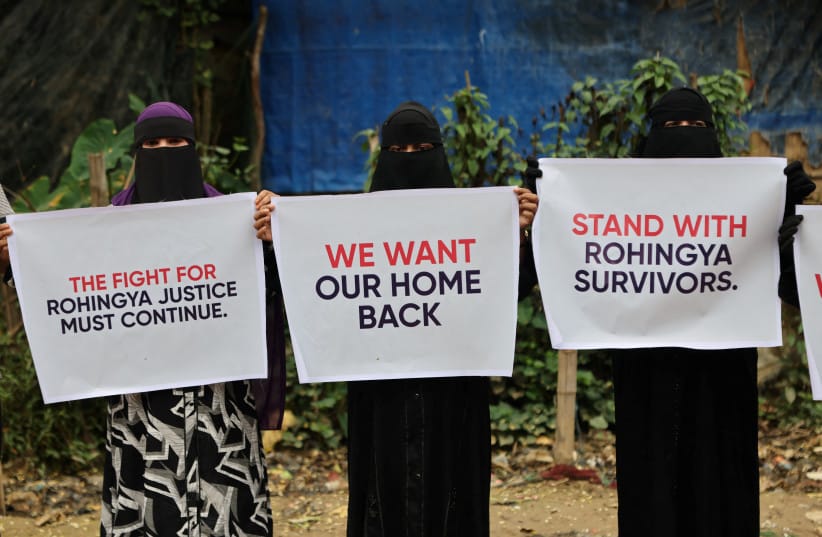
The ICJ acknowledged the burden of establishing breaches of the genocide convention but found that in this case, Myanmar intended to destroy part of the Rohingya minority.
Judge Iwasawa found that the scale and nature of Myanmar’s actions and methods went “well beyond what would be required to punish the population and are instead characteristic of an intent to destroy a substantial part of the group.”
“The court is of the view that the only reasonable inference that can explain Myanmar’s actions is an intention to destroy a substantial part” of northern Rakhine State’s Rohingya population, he added.
It also ruled that Myanmar failed to sufficiently investigate and prosecute perpetrators of genocide and failed to punish genocide under articles 1,4, and 6 of the Convention.
Interestingly, the ICJ ruling found that widespread destruction of housing can lead to a finding of genocide even in the absence of killing certain persons, and that acts committed by others, even if non-military, can be held against a country if it fails to stop them.
These are two rulings that may have set a precedent for future genocide cases.
Furthermore, the ICJ found that Myanmar’s killing of 1.2% of the Rohingya victim population – 10,000 out of 815,000 – is sufficient for a ruling of genocide. This is a significant downscaling of genocide given the case of the Holocaust, when six million Jews were killed – or Rwanda, where an estimated 800,000 people were killed.
Arsalan Suleman, partner at Foley Hoag and lead counsel for The Gambia, praised the judgment as a landmark victory for the Rohingya people and for “countless individuals in Myanmar who have endured violence at the hands of the military.”
Suleman also said it represents an important step toward accountability and honors the courage and perseverance of the victims and survivors who have spent years seeking justice.
Precedent for future cases
Though this is the first incident since the Holocaust in which an international court has convicted a state of genocide, it has previously convicted individuals of genocide, notably former Rwandan prime minister Jean Kambanda and Bosnian Serb military commander Ratko Mladic.
The legal threshold is exceptionally high: Where there is no explicit genocidal program, judges must conclude that genocidal intent is the only reasonable inference from the evidence.
In 2007, the ICJ ruled that the Srebrenica massacre constituted genocide but found insufficient evidence to hold Serbia responsible for committing it, despite having failed to prevent it.
Thursday’s ruling could have significant implications for South Africa’s genocide case against the Jewish state over the Israel-Hamas War. Parts of the ICJ ruling have arguably harmed Israel’s ability to mount a defense by lowering the standard of proof needed to be met to determine genocide against a country.
Additionally, following the ruling, Foreign Secretary Ed Miliband announced the expulsion of the Myanmar Defense Attaché from the United Kingdom and the summoning of Myanmar’s Chargé d’Affaires.
Yonah Jeremy Bob contributed to this report.