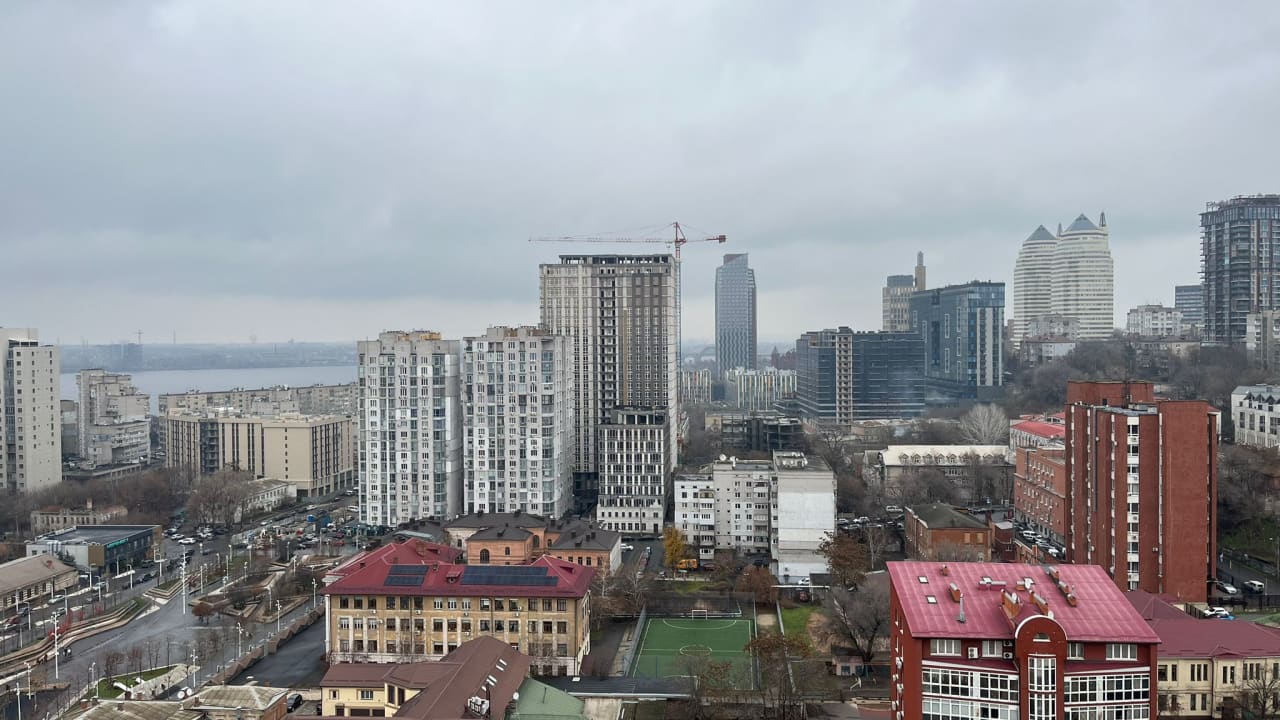
Some of the younger children of the Dnipro Jewish community cannot remember schooling without the sounds of sirens and the subsequent march to bomb shelters.
Under missile fire and drone attacks launched by the Russian forces that have invaded Ukraine, the children and their parents have strived to find a semblance of normality.
There were between 40,000 and 50,000 Jews in Dnipro before the war, according to community director Zelig Brez, though he noted that no one had truly been certain, since many were not religious or involved in the community.
Following the Russian invasion in 2022, many have fled the country, leaving between 15,000 and 20,000 Jews.
Some of those Jewish community members came from elsewhere around Ukraine, seeking refuge from the slow creep and receding of the trenches and front lines.

Defenses are being built within the city, not just at the front. Earth is being laid to cover a bomb shelter outside the Levi Yitzhak Schneerson school.
Every school needs to have a shelter that is open to the children and the surrounding public when the siren wails through the city. Educational institutions cannot operate without some form of shelter; schools without shelter hold classes at counterparts’ facilities and temporarily teach there.
When there are sirens at the Schneerson school, the lessons continue in the older basement shelter, as one teacher explained that the “sirens can be very long,” and if they stopped teaching, then there would hardly be a school day.
Sometimes the projectiles fall near. The school’s windows have been blown out twice. The attacks have damaged the area’s utility infrastructure, and as a result, Dnipro suffers frequent power outages as well.
Like many businesses, the school has diesel generators. These, according to the administration, keep the school’s lights on and are very expensive.
When a siren sounds, the children of the institution’s girls’ school make their way down the winding stairs into the shelter, chatting along the way and with no expression of dread. They are used to missile alerts and continue lessons as best they can in the basement.
A teacher explained that they try not to put an emphasis on the war, continuing as if there were nothing wrong, which prevents the students from getting stressed.
Plans for the new shelter include separate classrooms, bathrooms, and community spaces that will further insulate their studies from a war that seeps across the map from the east.
Thriving against all odds
Despite the war, the school has thrived, Brez said with pride. He grew up with little of his heritage, but now his children can speak Hebrew as well as he did Russian. The 500 students have a full secular curriculum, but also study Hebrew and Jewish studies.
The school, which has state-of-the-art electronic blackboards and specialized classes for its 13 students with special needs, provides an environment where students can excel regardless of circumstances.
According to the principal, the school prioritizes academics to remain competitive with other institutions. It is ranked the 10th-best school in the city.
The school ranked seventh in terms of the Ukrainian language, 10th in English, and 31st in mathematics in all of Ukraine.
At a local Jewish kindergarten, they managed to build a shelter so that they could continue to operate. The shelter room is used regularly for activities, so the small children are accustomed to being there and aren’t overwhelmed by being relocated to its safety.
A representative said that the daycare was overwhelmed during the first three months of the war, but managed to overcome the initial shock with the help of philanthropists and organizations such as Combined Jewish Philanthropies Boston.
Many of the institutions in Dnipro received support from foreign Jewish projects and expressed gratitude to their coreligionists abroad.
THIS INCLUDED the Jewish Medical Center (JMC), a multidisciplinary medical facility attached to the Menorah Center. During the early days of the war, it had to treat injuries from those barrages, as well as refugees from Mariupol and Donetsk.
Much of the center’s equipment is mobile, due to various demands that could arise during the war. The surgery room is equipped with a backup generator, as it “can’t be without electricity for even one minute,” according to one of the doctors. The vast majority of those treated by the JMC were gentiles.
The community’s nursing home was also occupied mostly by non-Jewish refugees from the east. Dnipro Chief Rabbi Shmuel Kaminetsky said that it was a time of war, and the community had to lend aid.
A local yeshiva that had 60 students from around the world before the war was reduced to 30 after the onset of the Russian invasion. At the beginning of the war, they had to study in the building’s hallways, away from the glass windows, which could shatter during attacks.
Now they have a shelter in the basement, where they can continue learning under Russian barrages. A yeshiva representative did not have much hope that the war would end anytime soon.
“We believe in God,” he said, a sentiment echoed by other religious Jewish Ukrainians when asked about their thoughts on the war’s possible cessation.
Holding out hope, holding onto optimism
Kaminetsky was one of the few Jews in Dnipro who hoped the war would soon end and remained optimistic about the future of the country, the city, and its Jewish community.
Ukraine and Russia had traded blows for four years, and both countries had been staggered by the war of attrition. Russia was faltering because of economic issues, Kaminetsky believed.
Ukraine does have enough people to fight, but has done a good job of protecting itself and preventing Russia from conquering the country, said the rabbi. Most Ukrainians were fighting out of a patriotic love for their country, but those who had held the line were tired.
“[Ukrainian President Volodymyr] Zelensky did an unbelievable job,” said Kaminetsky, saying that the country’s leader had taken a large risk by staying at the beginning of the war, and to bring it to a conclusion, he might need to take further action.
The rabbi believed that the “strong” and “determined” president would need to take other risks to see the war end, and long after that day, he would be remembered for winning the war and saving the country.
Brez shared that the war opened new opportunities for Dnipro’s Jews to reconnect to Judaism, finding purpose and hope amid the missile barrages. Kaminetsky had enough hope for all of them, believing that once the war ended, those who had left the city would return.
There is a war, but the Ukrainian people have spirit and can see beyond the dark clouds that block the horizon during the difficult winter. Ukrainians and Ukrainian Jews can see a future in which they could rebuild and flourish.
“Ukraine is alive,” said Kaminetsky.