
In the run-up to the September 2019 election – the second election that year – Israelis driving along the country’s roads were greeted by massive billboards showing a smiling Prime Minister Benjamin Netanyahu shaking hands with a beaming US President Donald Trump. The caption read: “Netanyahu. Another league.”
Similar posters from that campaign showed Netanyahu alongside Russian President Vladimir Putin and Indian Prime Minister Narendra Modi.
On Tuesday, in the run-up to October’s election, Israelis driving through Tel Aviv encountered a very different billboard. This one featured a stern Mojtaba Khamenei, Iran’s supreme leader, alongside New York Mayor Zohran Mamdani, Turkish President Recep Tayyip Erdogan and Hezbollah leader Naim Qassem. The caption read: “They want Netanyahu to lose. Don’t let them win.”
In 2019, Netanyahu ran on the prestige of those standing with him – chiefly Trump. In 2026, with Trump so far staying out of the election, Netanyahu is running on the fear inspired by those standing against him: Khamenei, Mamdani, Erdogan and Qassem.
What a difference seven years makes.
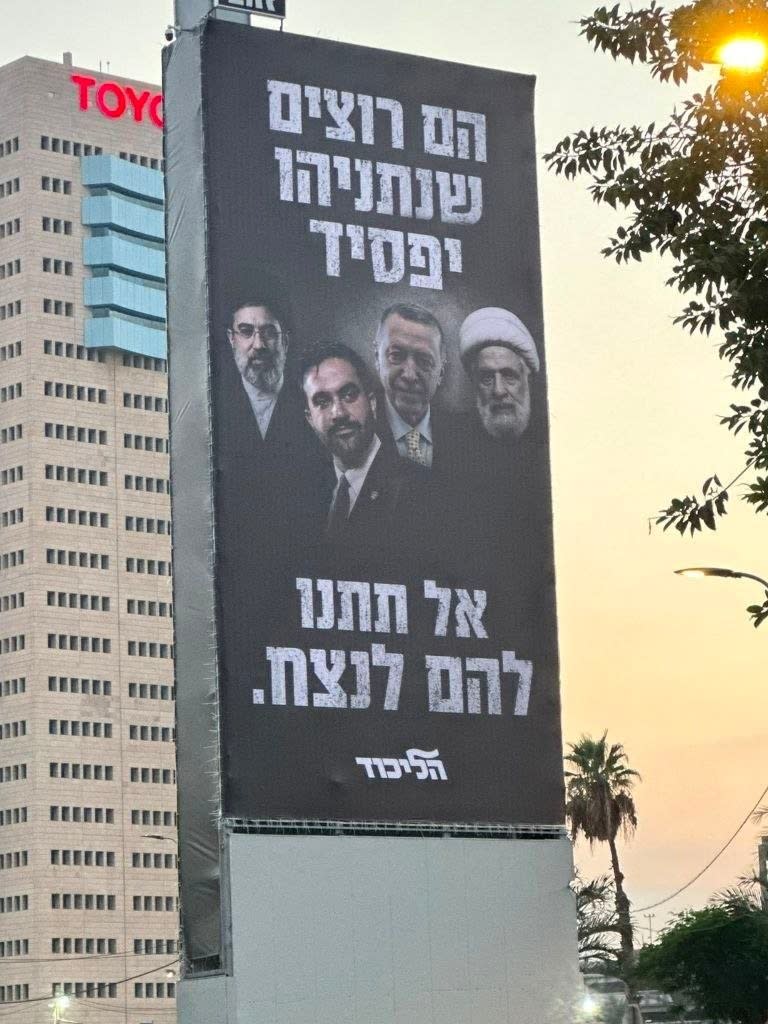
The contrast between the two billboards reflects more than a change in campaign tactics. It captures a fundamental change in Netanyahu’s appeal.
In 2019, the message was that Netanyahu’s relationships with powerful world leaders enhanced Israel’s standing. He was the man who could pick up the phone and reach Trump, Putin, and Modi. Their willingness to stand beside him showed that Israel – under his leadership – was diplomatically in another league.
In 2026, the message is different: Israel is surrounded by enemies and needs the man those enemies most want defeated. The equation is simple: If Israel’s enemies want Netanyahu out, Israelis should want him in.
Then, Netanyahu was running on the strength of the relationships he had built. Now he is running on the hostility of his enemies.
Trump says he should stay out of Israeli elections
Asked Monday about the upcoming Israeli election in a FOX News interview, Trump said: “I think it’s most appropriate for me to stay out of Israeli elections, but I may endorse somebody.”
Trump’s failure so far to endorse Netanyahu – as he has done in the past – may help explain the Likud’s pivot. Instead of putting the US president on its billboards as someone who wants Netanyahu to win, it is putting Israel’s enemies on them as people who want him to lose.
And Mamdani’s inclusion in this lineup is particularly telling.
Mamdani is obviously different from the other three. He does not command an army or battalions of terrorists and is not waging war against Israel. His importance to the Likud is symbolic. He represents the spread of hard-line anti-Israel politics infecting the Western mainstream.
The billboard does not necessarily suggest that Mamdani poses the same kind of threat as Khamenei, Erdogan, or Qassem. It does suggest that the Likud considers the political current he represents dangerous enough to place alongside the threats posed by Iran, Hezbollah, and Turkey.
And his inclusion is as ironic as it is telling.
Just as Mamdani used his bogus promise to arrest Netanyahu if he came to New York to rally his far Left base, Netanyahu is using Mamdani’s hostility toward Israel to fire up his hard-right base.
Each man benefits politically from the other. Mamdani uses Netanyahu as a symbol of everything his progressive supporters oppose; Netanyahu uses Mamdani as the face of a progressive movement implacably hostile to Israel.
And then there is the Trump factor.
Judging by his comment to FOX – that he may still endorse somebody – Trump apparently believes his endorsement could make a difference.
History does not bear out Trump's endorsements making a difference
But history does not necessarily bear that out.
Trump repeatedly took highly visible steps in the past that benefited Netanyahu shortly before Israeli elections.
Nineteen days before the April 2019 election, he recognized Israeli sovereignty over the Golan Heights. Three days before the September 2019 election, he tweeted that he had spoken with Netanyahu about advancing a US-Israel mutual defense treaty and looked forward to continuing those discussions after the vote. And a month and four days before the March 2020 election, he rolled out the Deal of the Century.
The Abraham Accords, unveiled in September 2020, came six months before the March 2021 Israeli election. But their timing had more to do with giving Trump a boost before his own election than with helping Netanyahu six months later.
All these moves were significant diplomatic achievements for Netanyahu. None, however, gave him a clear and decisive electoral victory. Even after the March 2020 election, when he managed to form a government, it was an unstable unity coalition that lasted less than a year.
Paradoxically, the election in that cycle of five elections over three and a half years that enabled Netanyahu to form a durable right-wing coalition came in November 2022, when Trump was no longer president, and the administration of then-president Joe Biden made no secret of its preference for a more centrist Israeli government.
A Trump endorsement, therefore, may not be all it is cracked up to be – especially since his standing among the Israeli public is not what it once was. Much of the country is concerned about how he is handling Iran and how he is restricting Israel’s freedom of action in Lebanon and Gaza.
The Israel Democracy Institute, which has carefully tracked Israelis’ attitudes toward Trump, found in March that 60% of Israelis believed that the country’s security was a central consideration for Trump. By July, that number had fallen to 28%.
And the part of this poll most interesting to Likud strategists is that the decline among right-wing voters – those Netanyahu needs to keep in his camp – was comparatively steep, falling from 70% to 35%.
In other words, the reason the Likud has Mamdani on the poster rather than Trump may not simply be that the US president has not yet endorsed Netanyahu. It may also be that, at this point, Mamdani’s opposition is more useful to Netanyahu’s campaign than Trump’s support.
Trump may yet endorse Netanyahu. And history shows that when he has acted to help him, he has often done so close to election day.
But the contrast between the billboards suggests that the Likud is no longer certain that Trump’s support carries the political weight it once did.
In 2019, Netanyahu asked Israelis to look at Trump standing beside him. In 2026, he is asking them to look at Mamdani, Khamenei, Erdogan, and Qassem standing against him.
Then, the message was: "See where I have taken Israel." Now it is: "See who wants me gone."