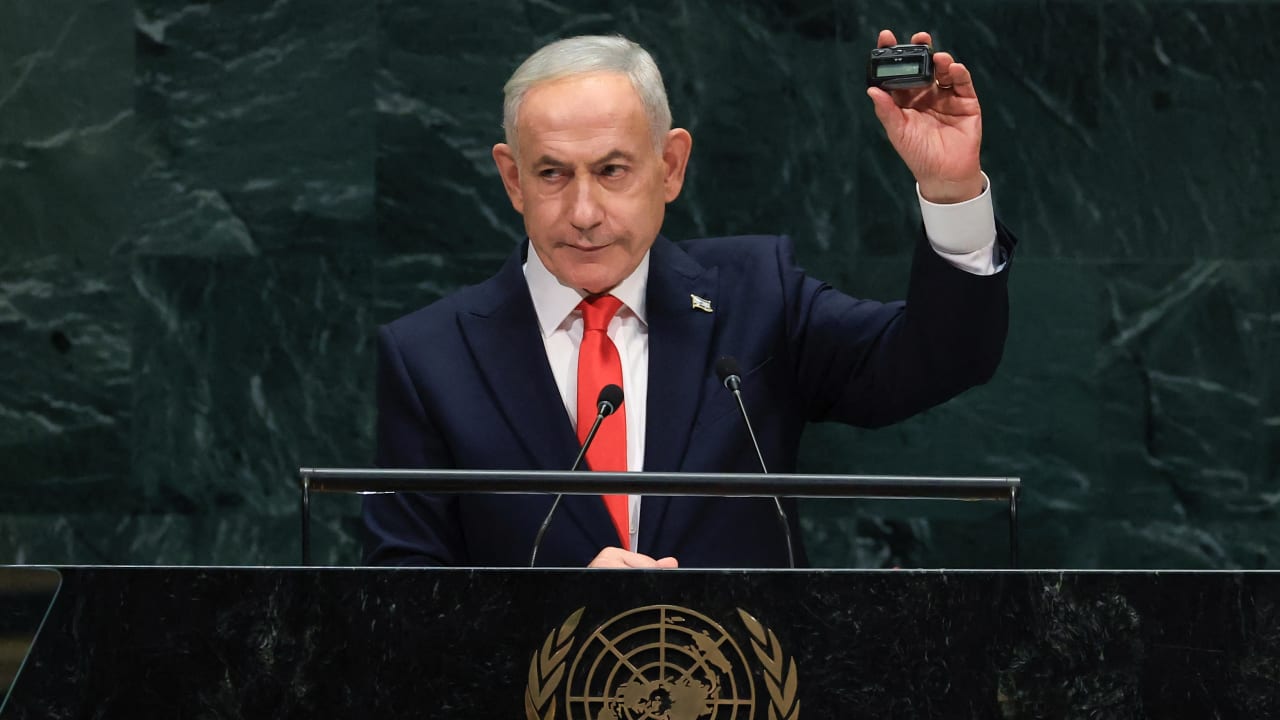
Prime Minister Benjamin Netanyahu flew to New York on Wednesday in search of one powerful campaign image, while apparently having to do without another.
The first was guaranteed: Netanyahu standing before the green marble backdrop at the United Nations podium, speaking flawless English and defending Israel and its soldiers before a hostile international audience just 33 days before Election Day.
The second – the prime minister standing alongside US President Donald Trump – was not on the schedule and appeared virtually impossible to arrange. Trump was due to spend Thursday in Washington with Chinese President Xi Jinping, while Netanyahu needed to leave New York that afternoon to return to Israel before Shabbat and the Sukkot holiday began.
Unlike prime minister Ariel Sharon, who almost always made a point of returning from trips abroad before Shabbat, Netanyahu generally has no qualms about spending Shabbat in a foreign city and flying home afterward. Last year, for instance, he delivered his UN speech on a Friday and met Trump in Washington on Monday.
But this year, in the middle of an election campaign, remaining abroad for the onset of Sukkot is not the image he wanted to project.

That scheduling mismatch – and the inability to arrange a Trump meeting – inevitably generated talk of a snub. But after eight Netanyahu-Trump meetings since the president returned to office, including one less than two months ago, saying that Trump was “snubbing” Netanyahu is an overreach.
Tellingly, Trump – who has so far pointedly stayed out of the election campaign and even told Fox News last month that it was “most appropriate for me to stay out of Israeli elections,” though at some point “I may endorse somebody” – posted a link on Wednesday to a Newsmax story about last week’s Channel 13 poll. That poll, for the first time, showed Netanyahu’s coalition outpolling the opposition Zionist parties, 54-50.
It was as if Trump were telling Netanyahu: “Look, Bibi, you might not get a photo with me this time, but here’s something.”
Never mind that by Wednesday evening, a more recent Channel 13 survey had overtaken that poll, showing the trend had reversed. The opposition Zionist parties, excluding the party of Yoaz Hendel and Yaron Zelekha, were now leading Netanyahu’s coalition – including Ofer Winter’s new party – 52-51.
Does Netanyahu need Trump to boost status before election?
The more pertinent question is whether Netanyahu needs another Trump photograph in this election at all – or, more precisely, how much such a photograph is actually worth electorally.
Previous steps by Trump to boost Netanyahu before an election – announcing US recognition of Israeli sovereignty over the Golan Heights 19 days before the April 2019 election, or rolling out the “deal of the century” one month and four days before the March 2020 election – did not produce a clear and decisive electoral victory.
Moreover, Trump’s standing with the Israeli public – and even with the Israeli Right – is not what it once was. A July poll by the Israel Democracy Institute found that the percentage of Israelis who believed Israel’s security was a central consideration for Trump had plummeted from 60% in March to 28%.
That does not mean a Trump endorsement would be meaningless. It does mean that the political value of another handshake may be less than it was seven years ago.
Netanyahu's UNGA speeches as a diplomatic tool
IF THE Trump photograph was missing, however, the UN photograph was guaranteed – and in this campaign, it may be the more valuable of the two.
Thursday’s speech marked the 15th time Netanyahu has addressed the UN General Assembly in person as prime minister. In 2020, amid the COVID pandemic, he spoke via prerecorded video.
Each time he has spoken there, he has addressed three distinct audiences: the diplomats in the hall and their bosses back in their countries’ capitals; the international – primarily American – public; and the Israeli public. Each time, however, the speech has been aimed chiefly at one of those audiences.
The best example of a speech directed toward the diplomatic community came in 2011, when Netanyahu took the podium shortly after Palestinian Authority President Mahmoud Abbas formally submitted a bid to the UN secretary-general for full recognition of a Palestinian state.
Netanyahu argued that peace could not be manufactured through UN resolutions, even though the organization’s “automatic majority can decide the sun rises in the west.”
This was a direct appeal to the various delegations not to recognize Palestine as a UN member state.
His message was aimed more at diplomats than at the public, and to appeal to them he reiterated his commitment to his 2009 Bar-Ilan University address, confirming on the global stage that he would accept a demilitarized Palestinian state alongside a recognized Jewish state.
That was Netanyahu using the annual UN General Assembly speech as a diplomatic tool.
The very next year, in 2012, he used the same podium to go over the diplomats’ heads and speak directly to international public opinion.
That was perhaps his most memorable UN address – the one in which he drew a thick red line across a Wile E. Coyote-style cartoon bomb to demarcate the point beyond which Iran must not be allowed to advance toward nuclear weapons.
The move was designed to bypass the world leaders in the room and appeal directly to the public. It was built for the television camera and aimed at the person flipping channels in Iowa or Florida who could glance at the screen and immediately understand Israel’s geopolitical predicament.
That speech, delivered in late September 2012, came just six weeks before the highly contested US presidential election between Barack Obama and Mitt Romney. Netanyahu was then locked in a bitter disagreement with Obama over the need to establish redlines for Iran.
Recognizing that he was making no headway with the president through traditional diplomatic channels, Netanyahu took his case visually to the American people. They were his core audience.
On Thursday night, however, the core audience was neither the diplomats in the hall – nor those watching from outside after choosing to boycott the speech – nor the broader international public.
This time, the core audience was the Israeli public, which will vote in another 33 days and determine whether this UN address may have been Netanyahu’s last as prime minister.
Of all the times Netanyahu has addressed the UN General Assembly, this was the first during an Israeli election campaign. The only previous speech that came even close was the redline address of 2012. New elections were called two weeks after Netanyahu returned home and were held in January 2013.
Interestingly, Netanyahu did not meet the US president during that trip either – though in 2012, unlike now, it genuinely was an Obama snub.

Netanyahu running off hostility of enemies, not endorsement from allies
THE OPTICS of another handshake with Trump would undoubtedly have been beneficial to Netanyahu’s campaign. In this particular campaign, however, images of him rebuking a hostile world may be just as valuable – if not more so.
During the September 2019 campaign, photographs of a smiling Netanyahu shaking hands with Trump were everywhere.
The message was that Netanyahu was diplomatically in another league and could pick up the phone and reach any world leader he wanted: Trump, Russia’s Vladimir Putin, or India’s Narendra Modi.
Netanyahu was then running on the strength of the diplomatic relationships he had built.
Now he is running on the hostility of his enemies.
And no venue in the world embodies that hostility more than the United Nations. Netanyahu standing there, standing up to a hostile world – to France’s President Emmanuel Macron, Britain’s Prime Minister Andy Burnham, New York City Mayor Zohran Mamdani, Turkish President Recep Tayyip Erdogan, and many more – is potentially more valuable in this campaign than another photograph with Trump.
The Israeli public already knows that Netanyahu meets regularly with the US president. Faced with waves of international hostility washing over Israel, what may sell now is the ability to push back against that hostility.
That was the image Netanyahu set out to create on Thursday night, and the audience for it was not the world but Israel’s voters.
Netanyahu’s senior adviser, Yonatan Urich, has already run a mocking social media post contrasting the prime minister’s English with that of Gadi Eisenkot. The UN speech drove that message home in real time.
But does it matter?
Are those voting for the Democrats, for instance, going to hear Netanyahu’s UN speech and say, “Wow, that’s the defender we need on the world stage?” Obviously not.
But those wavering between Netanyahu’s Likud and Eisenkot’s Yashar, or considering one of the smaller parties in either bloc, may be influenced by a virtuoso performance on the world stage that they fear Eisenkot may be unequipped to deliver.
Netanyahu apparently believes it matters. Otherwise, why make a grueling 24-hour transatlantic trip without a guaranteed meeting with the president?
Much has been written over the years about Netanyahu’s use of props and gimmicks at the UN to make his point.
The cartoon bomb was the quintessential prop, but there have been others. In 2009, he waved the original Nazi blueprints of the Auschwitz-Birkenau concentration camp to combat the Holocaust denial being preached by then-Iranian president Mahmoud Ahmadinejad, who had addressed the world body that year.
In 2015, Netanyahu stood in complete silence for 44 seconds at the podium to protest the world’s “deafening silence” regarding Iran’s threats to destroy Israel.
And in 2023, just before October 7, he stood at the podium with a green marker and displayed a map illustrating a “new Middle East,” highlighting the potential normalization agreement with Saudi Arabia that at the time seemed very much in the air.
This year, the UN itself – green marble backdrop and all – was the prop: Netanyahu using it adroitly to portray himself as the man willing and uniquely able to enter the lion’s den and confront the world.
But will it play in Petah Tikva? Will it matter when Israelis vote? Or is this election so dominated by responsibility for October 7 and the haredi (ultra-Orthodox) draft that this kind of political theater will not make a dent?
Judging by the time and effort Netanyahu put into making this trip so close to the election, he apparently believes it might.