
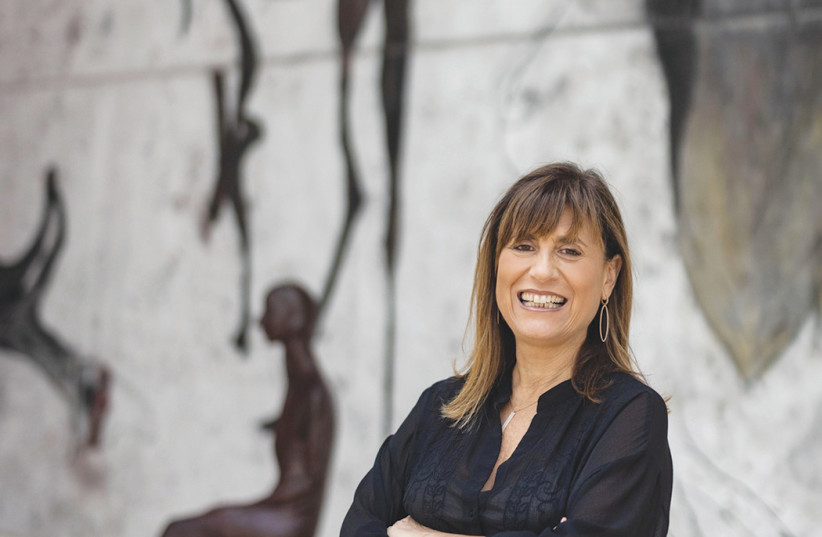
After weeks when museums across Israel were closed, and daily life moved between sirens and shelter, Tania Coen-Uzzielli, director of the Tel Aviv Museum of Art, began thinking differently about space, access, and presence.
“I am sitting in a protected space and thinking that underneath me, in another protected space, there is this exhibition,” she says, recalling the moment the idea began to take shape.
She made the comment as I joined one of the museum’s special tours shortly before a ceasefire was announced. The tour’s name, “The Event Has Not Ended,” plays on a phrase that has become almost ritual in Israel during weeks of sirens: the automated phone notification announcing that “the event has ended” once a threat passes. It is a small, clinical message that signals safety but also the uneasy return to something that never quite feels fully resolved. The museum takes that logic and quietly turns it inside out. The event, it suggests, never really ends. It only shifts form.
There is a stark, almost physical reality in the image Coen-Uzzielli describes: two protected spaces, stacked one above the other, each designed for safety. This physical proximity between the hidden collection and the seeking public suggested a new way for the institution to exist. What followed was not a reinvention of the museum but a recalibration. It was a way of letting culture continue to function inside a situation in which “normal” is no longer a working assumption, and where routine and rupture now sit far too close to separate cleanly.
Adjusting the grammar
The tour begins in the empty halls where the exhibition had been installed before the war. The works are no longer on the walls, but their absence is not neutral. It is almost tactile. You move through the space with the sense that something is still there, just temporarily displaced, waiting for conditions to allow its return.

For a moment, it almost feels like nothing has changed. The controlled light is the same, the measured silence is intact, the slow unfolding of attention still part of the language of the museum. The guide explains the exhibition while pointing to where the works were hung, the empty squares of light still visible on the walls, like after-images of what was there only days before. In some rooms, two simple chairs are placed in the center of the floor, facing these rectangular voids. It is a quietly unsettling arrangement, turning the gallery into a space for both viewing and waiting.
But the change is already embedded in what followed. After weeks when museums across Israel were closed, the works were taken down from the walls and moved into reinforced protected spaces downstairs. This is standard procedure in moments of risk, a way of ensuring that what is on display is not exposed to potential damage.
What is not standard is what Coen-Uzzielli came up with next. Instead of only taking down the rare works of The Day Is Gone: 100 Years of the New Objectivity or shifting the exhibition into a purely digital format, she created a guided tour inside the protected space. She chose this particular exhibition because it is rare, because it had already been a success before the war, and because it felt important that people would still have the chance to see this important show.
The result was not a change in display but a change in experience. We were not simply encountering works that had been moved for safety. We were moving through an organized, curated experience built around them there, with a guide, pacing, interpretation, and live piano music. The shelter became not a pause in the museum experience but its setting.
The necessary move
“Only unusual times invite unusual action,” she says simply. “And this is an unusual action because we are in an unusual time.” The sentence carries the logic of the entire project: not transformation for its own sake but adaptation under constraint. The idea formed during a period when the museum’s most significant success of the year was at stake, and the tour aims to allow people to continue experiencing these works despite the war.
At the center of the tour sits ‘The Day Is Gone: 100 Years of the New Objectivity.’ Curated by Dr. Noam Gal, this exhibition of approximately 130 works from Germany (1920–1939) brings together painting, drawing, photography, and print from a period defined by the fragile instability of the Weimar Republic and the collapse that followed. These exceptionally rare and valuable works represent a major institutional achievement.
Artists – which include George Grosz, Otto Dix, Christian Schad, Rudolf Schlichter, Lotte Laserstein, Anita Rée, and Greta Jurgens – developed a visual language stripped of emotional cushioning. It is realism without reassurance. The works operate through precision rather than expression. Figures appear close together yet remain disconnected. Streets feel observed rather than inhabited. Faces are rendered with a clarity that feels almost clinical, as if sentiment has been removed in order to expose something harder underneath.
Rudolf Schlichter’s watercolor Passers-by and Soldiers carries this tension with particular force. Encountered in the museum’s altered format, the work does not become more relevant. It becomes more immediate. The distance between image and viewer narrows, not as interpretation but as atmosphere.
A specially produced audio drama extends the experience further. It reconstructs a day in 1920s Berlin, moving through cramped apartments, crowded streets, political demonstrations, and fragmented social encounters in bars. It does not explain the works. It surrounds them. Coen-Uzzielli is careful about resonance. “Those times between the wars, with the anxiety of the people, the people who almost do not look at each other, it speaks with our time,” she notes.
A significant part of its presence in Tel Aviv is also tied to the gesture of German collector Jan Fischer, who chose this moment to lend his collection publicly in Israel for the first time. The rarity and scale of the works are considerable, and Fischer described the loan as an act of cultural openness during a period of international strain.
Presence and community
Outside the exhibition space, the museum operates in a more distributed form. When physical access became limited, programming expanded outward rather than contracting inward. Digital screenings replaced some in-person visits. Workshops were adapted for families in shelters. Online sessions were created for older audiences unable to leave home. Art kits were distributed to communities that could not reach the museum at all.
“We discovered that many things can be done even when we are closed,” says Coen-Uzzielli. The institution becomes less a single destination and more a network of partial access points, adjusting itself to conditions where presence is no longer guaranteed in one place at one time. The question shifts from who enters the museum to how the museum remains reachable at all.

That continuity is reflected in another layer: visibility. Despite disruption, the museum recorded more than one million visitors and was ranked among the 100 most visited museums in the world by The Art Newspaper, the only Israeli institution on the list. The number functions as evidence of continuity under pressure.
The persistence of the event
“In the midst of war, this is encouraging news that brings pride,” says Coen-Uzzielli. “We continue to respond and act all the time according to the changing reality, out of the belief that art and culture are a vital necessity in the lives of every citizen.”

There is no attempt to smooth the contradiction between institutional steadiness and lived instability. The museum does not step outside that tension. It works inside it.
As the tour ends and visitors step back into the Tel Aviv streets, nothing resolves into closure. But the experience does not feel incomplete, either. It feels extended, like something that continues beyond its own frame.
The museum does not offer escape from interruption. It offers a way of staying with it. And in that sense, the event does not end. It simply changes form.