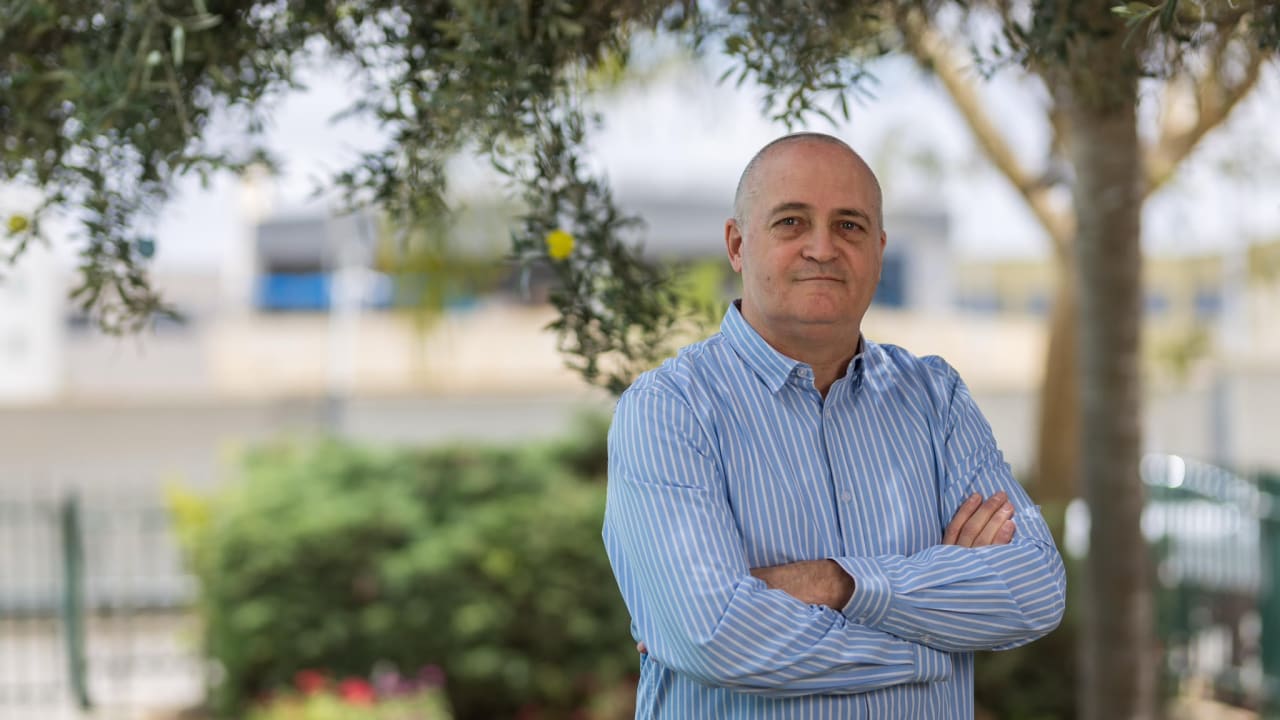
‘When I assumed my position as chairman of HaBithonistim,” says Brig.-Gen. (res.) Erez Winner, “I defined the greatest threat to Israel as the war for our home.”
Winner, who succeeded the organization’s founder, Brig.-Gen. (res.) Amir Avivi this past June, says that Israel faces a reality in which hundreds of thousands of illegal weapons are now in the hands of criminal gangs in the Arab sector.
These weapons, he says, have been smuggled in, particularly during the past two years, from Jordan and Egypt, while others have been stolen from IDF bases. Those gangs are responsible for most of the violent incidents in Israel in recent years, Winner adds, and the violence has continued to rise.

About a month ago, Winner continues, Raed Salah, head of the Northern Branch of the Islamic Movement – who is outside the law and has served time in prison – brokered a reconciliation between the two largest crime families in the Israeli Arab sector. “If he can reconcile the two largest criminal organizations, he can also send them to do other things tomorrow,” he says.
Winner recalls a terror attack that took place in early June, when an Israeli Arab terrorist, armed with an improvised Carlo submachine gun, went to the Tzur Yitzhak-Kochav Yair area, carried out an attack, and killed and wounded civilians.
“This is only a very small example of what could happen tomorrow morning in six or 10 places simultaneously, using more sophisticated weapons,” he says.
Moreover, he says, the Palestinian Authority is a hostile, armed, and dangerous group with tens of thousands of armed personnel. “When they decide that they want to open a war against us, and if they join forces with the illegal weapons spread throughout Israel, that will constitute the true, significant, and, in my opinion, the only existential threat to Israel.”
Along with these internal threats, he observes, Israel faces threats from numerous countries in the region. “This does not mean we are finished with Iran, Lebanon, or Gaza; that Turkey should not concern us; or that Egypt – and even Jordan, should it fall into the hands of the Muslim Brotherhood tomorrow – does not present a potential threat.”
Victories over Israel’s external enemies, says Winner, will only be achieved if Israel shifts its security doctrine away from the policy of containment that took shape over the past twenty years and returns to the traditional doctrine of decisive victory. When Israel acts in this manner, he continues, it can deter its enemies.
“Deterrence is a very elusive concept,” he shares. “If you were to ask me for an example of Israeli deterrence, I would point to the past two weeks, during which the Iranians have attacked every country in the Middle East except Israel. Neither Iran nor the United States wants Israel to take part in the war at present. That is deterrence: the Iranians know that Israel can strike them extremely hard and is also fairly capable of defending itself.
“The Americans likewise know that Israel can strike very hard, and at present they do not want that. So that is deterrence. The problem is that it is difficult to manage this concept on its own. To claim that you genuinely possess deterrence, you must also employ the method I mentioned: enforcement and prevention. You must continually prevent the enemy from building up or becoming too strong, and make it understand that you can strike it anywhere.”
Winner says that Israel can balance the need to eliminate immediate threats with the pursuit of long-term stability. In fact, he says that the only way that either can be achieved is by pursuing them together.
“For many years,” he asserts, “from the Camp David agreements through Oslo, the withdrawal from Lebanon, and the disengagement, we approached matters on the assumption that if we only gave the Arabs more territory, better terms, or permission to do various things, they would sign a piece of paper and we would have peace.
“We have seen that this does not work. The current approach, as reflected in the agreements we signed concerning Gaza and Lebanon, is peace through strength. Israel’s doctrine over the past two years – a doctrine of peace through strength – is the approach that can truly produce peace.”
This type of approach, he says, will enable Israel to expand the Abraham Accords to other countries.
“Our opportunity is now, when we are strong. The Gulf states see what we did in Iran. They see our relationship with the United Arab Emirates, our partner in the Abraham Accords, and they have an interest in cooperating with us. When the United States and Israel fight side by side, people understand that we are a regional power.”
Returning to the lessons that Israel has learned since Oct. 7, Winner says that the size of the IDF must be enlarged. “It is not that we did not know this – we have been saying it for years – but the army is too small for the missions assigned to it.
“We see that today, as it is stretched throughout Lebanon, Judea and Samaria, and Syria. The IDF does not have enough combat formations in either the standing army or the reserves. That is the first thing that must be addressed.”
Second, he says Israel needs to improve its capability to defend itself against drones and other autonomous systems.
“If there is one thing this war has taught us – although we should not have waited for this war, because it was already evident in the Russia-Ukraine war, which we did not examine closely enough – it is the importance of autonomous systems and drones of various kinds. We are already beginning to see these drones operated by AI systems and in swarms. This is the next major threat.”
A third important lesson is what Winner calls security sustainability. Israel must ensure that it is not overly dependent on the decisions of one person, government, or administration, as happened during the war under the Biden Administration.
Together with Prof. Gabi Siboni, a senior researcher at the Jerusalem Institute for Strategy and Security, Winner wrote the draft of a new national security doctrine that would include this feature.
“We must diversify our sources,” he says. He cites the example of D9 bulldozers, which the army needed for the war in Gaza.
“I remember how much time we spent at Southern Command dealing with the issue when President Biden halted their supply. Bulldozers can be purchased from many companies, not just one. Caterpillar is not the only company in the world that sells them. In an article we wrote on this subject, we cited German, Austrian, Japanese, and Indian companies.
“That is a very simple example, but the same principle must be applied in other critical fields: diversify our procurement sources rather than buying from only one supplier; find several sources; increase our stocks of raw materials; and restore our domestic manufacturing capacity.”
Finally, Winner touches on how division within Israeli society can affect the country’s national security, and how political uncertainty can affect the defense establishment’s preparedness.
He is deeply troubled about the divisions within Israeli society. “It is no secret that historically we have tended to fight among ourselves. If you read Josephus’s The Jewish War, it tells a story from 2,000 years ago; if you look at our conflicts here, you see the same tendency.”
“This polarization is not unique to us,” he continues. “You see it throughout the world, certainly in the Arab world, in the United States today, and elsewhere. The center is shrinking, and the extremes are growing. In terms of the familiar bell curve, the curve is becoming flatter and larger at its edges. Extremism is increasing.”
Regarding Israel's upcoming elections in October, Winner is concerned about two factors – what he terms “the extraordinary intervention by international actors, and the polarization of the political system.”
Winner says that online bots, created by countries hostile to Israel, such as Iran, Qatar, Turkey, and possibly Russia and China, are being used to fan the flames of hatred within the country between different sectors. In professional terms, it is called “soft warfare,” and its usage has increased in recent years.
The polarization of the electorate into those who want to keep Prime Minister Benjamin Netanyahu and those who want him to be defeated is unfortunate, he says.
“Because of this polarization – and particularly the ‘Netanyahu or not Netanyahu’ question that divides the Israeli political system in two – we see an absurd reality in which parties that define and declare themselves Zionist say, ‘We will not sit with the Likud or with Netanyahu, but we will be willing to sit with the Muslim Brotherhood party.’
“Assessing every issue according to whether it advances the effort to topple Netanyahu, rather than according to what is important, ignores the threats – particularly the security threats – that do not disappear.”
The most important legislation that must be dealt with after the elections, he says, is enacting a national civil service law: “Such a law would say something very simple: every citizen of Israel must share the burden. The military receives priority because we still face a significant security threat. The army selects first and takes those whom it needs.
“Yet we know that even today it does not need everyone. It needs more combat soldiers, but if you walk around the Kirya you will see many people whom the army probably needs less, and the same is true elsewhere. Under a National-Civil Service Law, everyone would serve: Haredim, Arabs, and women who wish to serve, each according to their circumstances and ability to contribute.
“This could also solve many problems in Israeli society – for example, the shortage of caregivers. Instead of continually seeking another Filipina caregiver for our grandparents, people could serve in nursing care, firefighting, the police – which must be expanded considerably – and agriculture in the periphery.
“Plans were also proposed but unfortunately fell victim to the foolish dispute over the conscription law and its clauses, to establish haredi yeshivas in border areas, in the Jordan Valley, the Arava, and elsewhere, along the lines of Nahal groups, where participants could study Torah and also provide security.
“There are many other possibilities. I believe this is the most important legislation that any government defining itself as Zionist should advance after the elections.”
Winner concludes by pointing out that the HaBithonistim organization is not only invested in safeguarding Israel’s security, but in improving Israel’s educational system.
“Our educational activity ranges from lectures in schools and pre-military academies to a pre-military academy that we established a year ago in memory of Omer Smadga, z”l, in Tekuma in the south, near the Gaza border. [Smadga, 25, was killed in a Hamas mortar attack in the central Gaza Strip on June 20, 2024.]
“We are also establishing the first pre-police academy of its kind, preparing students for combat roles in the Border Police and the Israel Police, in memory of Ran Gvili, a heroic police fighter who was killed fighting Hamas terrorists near Kibbutz Alumim on Oct. 7, 2023.
“In addition, as part of the recruitment effort we discussed, we are establishing a haredi pre-police academy that will bring haredi personnel into the police. This concern for future generations includes these fields, as well as international affairs, antisemitism, and many other matters. They are all pieces of the same puzzle.”
This article was written in cooperation with HaBithonistim.