
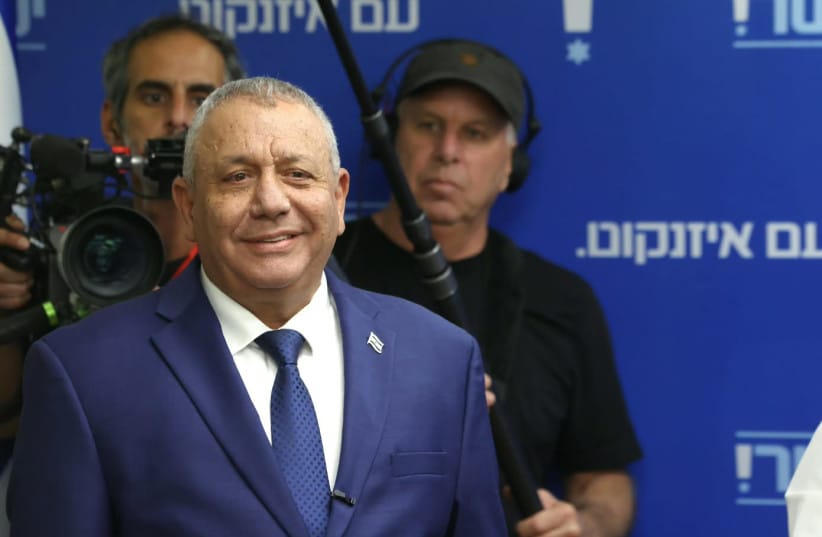
Negotiating teams representing the Yashar party, led by Gadi Eisenkot, and Prime Minister Benjamin Netanyahu’s Likud met on Sunday afternoon for a roughly four-hour meeting to continue talks on a potential unity government.
The central issue of forming a rotation government was not discussed at the meeting, Eisenkot's office confirmed to The Jerusalem Post, without elaborating further on the discussions.
Likud and Yashar announced in a joint statement after the meeting that a follow-up meeting would take place, without stating when. The parties added that the sides had presented their positions on "a range of substantive issues and held detailed discussions on them."
The issues reportedly discussed included haredi (ultra-Orthodox) conscription into the IDF, judicial reform measures, a state commission of inquiry into government failures on October 7, and the possibility of forming a government without the far-right Otzma Yehudit party, led by National Security Minister Itamar Ben-Gvir.
Likud sent MK Ofir Katz and Michael Rabello, Netanyahu’s former personal attorney, who recently withdrew his candidacy for state comptroller amid controversy over the integrity of the election process, to represent the party at the meeting. Yashar sent MK Chili Tropper alongside Yoav Horowitz and Guy Gutman.
Representatives from the Eisenkot-led bloc met with Likud last Sunday as part of efforts to explore the possibility of forming a unity government, later announcing that the talks would continue and describing the initial discussions as “businesslike.”
A representative from Naftali Bennett's B'Yachad party, who was present during the meeting last week, did not join the fresh round of negotiations on Sunday.
Katz reportedly said ahead of the meeting that the Likud negotiating team was hoping for genuine talks that were "not just for appearances."
Planned talks part of effort to form new gov't
Yashar said on Saturday that the planned "marathon of talks" was part of efforts to "form a new government and exhaust every possible avenue."
"The Yashar negotiating team will work to turn over every stone, enable bold moves, and achieve a breakthrough that will lead to the formation of a government," the statement added.
Eisenkot had previously drawn a red line against serving in a government headed by Netanyahu and has laid out four key principles that MKs must accept if they wish to join his coalition.
Netanyahu has repeatedly called for a unity government after his bloc lost its parliamentary majority to the Eisenkot-led bloc following the October 27 election.
On November 8, Eisenkot received the mandate from the president to form the next government, giving him 28 days to do so, with the option of requesting an additional 14-day extension.
The party leaders of the Eisenkot-led bloc – Bennett (B'Yachad), Avigdor Liberman (Yisrael Beytenu), and Yair Golan (the Democrats) – all said last week that Netanyahu must be ousted. However, they have separately expressed differing views on how a government should be formed following the political deadlock that emerged after the election.
Liberman and Golan have drawn a red line against joining a unity government led by Netanyahu.
As the negotiations were taking place on Sunday, Golan reiterated his opposition to a unity government, instead calling for the formation of a minority government.
A minority government could potentially be formed with the backing of the Arab parties, through a Knesset confidence vote that secures a simple majority rather than an absolute majority of 61 seats.
"A minority government is currently the only realistic alternative. If the delays are part of a negotiating tactic, it is time to end the games," Golan stated.
He added that anyone seeking to form a unity government with Netanyahu would be "stabbing their voters in the back."
The Democrats chairman stated that the party leaders in the Eisenkot-led bloc "were elected to replace Netanyahu, not to sit with him. Therefore, the Democrats will oppose any such unity arrangement."
Golan further called for cooperation with the Arab parties – Ra’am and the Joint List – saying that the possibility of working with them “must be examined seriously, rather than ruled out in advance, certainly not for ulterior motives that reek of racism.”
Liberman has meanwhile opposed the possibility of forming a minority government, saying that such an arrangement would be unstable and ultimately lead to another round of elections. Instead, he has called for partnering with the haredi (ultra-Orthodox) parties and forming a government with them.
The Yisrael Beytenu leader's stance has drawn criticism, as ahead of the elections, Liberman had taken a hardline position against partnering with the haredi parties, demanding legislation to draft all haredim into the IDF.
Golan's statement on Sunday also said that the formation of a government should not be solely dependent on reaching an agreement with the haredi parties.
"If there is no agreed framework for cooperation with the haredi parties, negotiations with them must not become a condition for forming the government. It is possible to form a government and negotiate with them afterward, from a position of strength as an incumbent government," Golan stated.
Though party leaders in the Eisenkot-led bloc have recently opened the door to coalition negotiations with the haredi parties - Shas and United Torah Judaism - they have been key partners in Netanyahu's coalition, making it unclear whether they would agree to join a government led by Eisenkot.
Bennett openly backs unity gov't with Likud, led by Eisenkot
Meanwhile, Bennett on Saturday openly backed the formation of a unity government with Likud, provided it was led by Eisenkot, while stating that he was committed to not joining Netanyahu's bloc “under any circumstances.”
Bennett's statement on his position came after he met with Netanyahu in the prime minister's Knesset office last week, without Eisenkot's prior knowledge, sparking speculation over his intentions. The B'Yachad leader had remained silent on his stance immediately after the meeting.
The October 27 election results showed that the bloc seeking to replace Netanyahu won 67 seats, including 19 held by the Arab parties, while Netanyahu's bloc secured 53 seats.
No government has been formed yet, as most party leaders have drawn a red line against partnering with the Arab parties.
Nevertheless, Arab party support has allowed the bloc to advance key legislation in the Knesset even while Netanyahu heads a caretaker government.