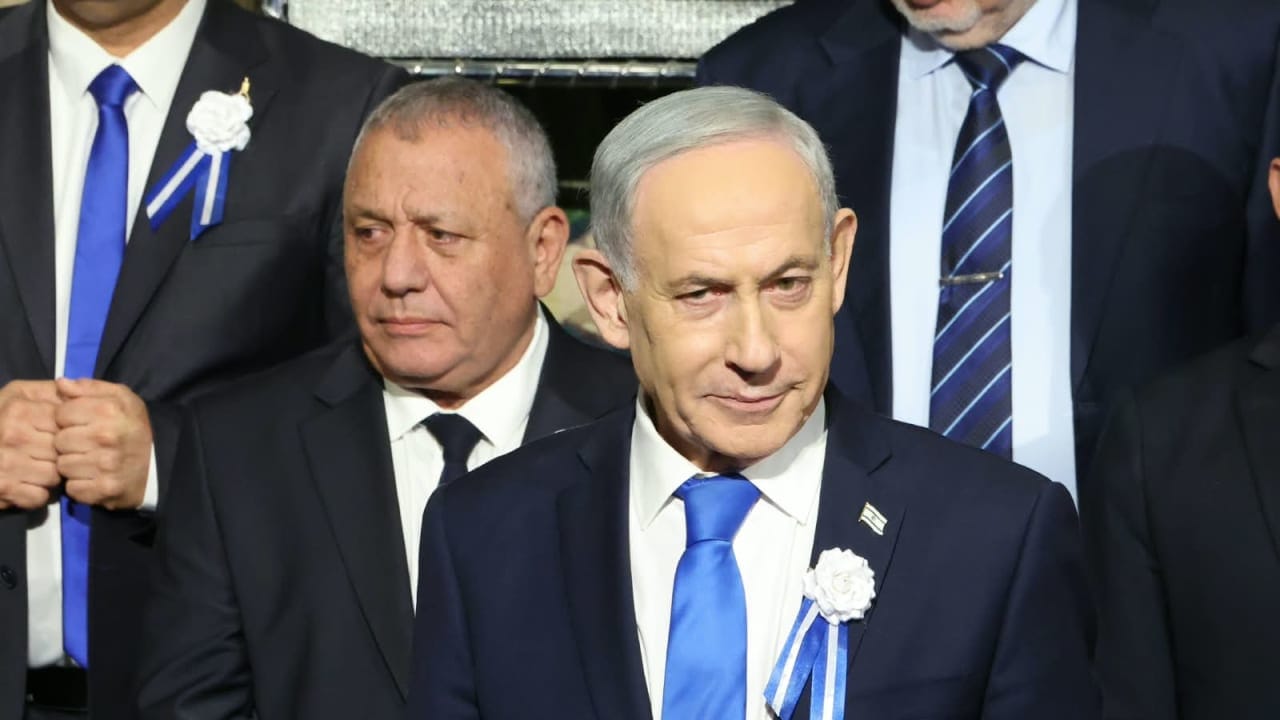
The bloc seeking to replace Prime Minister Benjamin Netanyahu appeared to make progress toward forming a government with the haredi (ultra-Orthodox) United Torah Judaism party on Wednesday.
Simultaneously, negotiating teams representing Gadi Eisenkot’s Yashar party and Netanyahu’s Likud met to continue talks on a potential unity government between the two blocs.
The meeting between Yashar and Likud representatives marked the fourth round of negotiations between the two sides in the past two weeks.
Earlier on Wednesday, Yisrael Beytenu chairman Avigdor Liberman said that negotiations with Yashar had effectively concluded and that progress had been made in talks with UTJ in an interview with KAN Reshet Bet.
“There will be no minority government; there will be a government with a Jewish majority. United Torah Judaism MKs have received the green light from their rabbis, and things are progressing very well,” he said.

The remarks marked the first time Liberman had publicly called for a government with “a Jewish majority,” prompting speculation that he would agree to a government with the haredi factions, backed by an Arab party such as MK Mansour Abbas’s Ra’am.
The leaders of the parties in the Eisenkot-led bloc – Naftali Bennett (B’Yachad), and Yair Golan (the Democrats), and Liberman – all said last week that Netanyahu must be ousted.
Netanyahu has repeatedly called for a unity government after his bloc lost its parliamentary majority to the Eisenkot-led bloc following the October 27 election.
Golan, Liberman differ on alternatives to unity government
On Sunday, representatives from both sides met for approximately four hours and discussed a range of topics, although the central issue of forming a government through a rotation agreement was not said to have been addressed. The representatives met again on Monday for around two hours, saying that the talks had focused on judicial matters.’
A day later, Golan’s Democrats party announced that it had halted coalition talks with Yashar over the continuation of unity government negotiations with Likud.
“We, the Democrats, are committed to forming a government that will end Netanyahu’s rule. The option of a unity government must be taken off the table, and we must understand that replacing the prime minister cannot simply mean changing the names,” the party stated on Wednesday.
Golan has also reportedly been demanding one of the three most senior ministerial portfolios in Israel’s next government, seeking to head one of the Defense, Foreign, or Finance Ministry, Israeli media reported on Wednesday.
Should Golan fail to secure one of the three portfolios, he would reportedly demand two ministerial positions relevant to his party’s agenda, with the education and justice portfolios among those he sought.
However, according to reports, the Yashar party intends to offer Golan the national security portfolio.
Golan has called for the formation of a minority government and further cooperation with the Arab parties – Ra’am and the Joint List. He said that the possibility of working with them “must be examined seriously, rather than ruled out in advance, certainly not for ulterior motives that reek of racism.”
Liberman, meanwhile, has also opposed a government with the Arab parties, as well as the possibility of forming a minority government.
He has argued that such an arrangement would be unstable and ultimately lead to another round of elections. Instead, Liberman has called for partnering with the haredi parties and forming a government with their support.
The Yisrael Beytenu leader’s stance has drawn criticism. Ahead of the election, Liberman had taken a hardline position against partnering with the haredi parties, demanding legislation to draft all haredim into the IDF.
Bennett backs unity government under Eisenkot's leadership
Meanwhile, Bennett has openly backed the formation of a unity government with Likud, provided it was led by Eisenkot, while stating that he was committed to not joining Netanyahu’s bloc “under any circumstances.”
Bennett has also expressed support for a rotation agreement, with Eisenkot serving first as prime minister.
The B’Yachad later said on Monday that it was considering all options for forming a unity government, warning that Netanyahu would bear the consequences if he was found to be deliberately “seeking to waste time” rather than pursuing a unity government led by Eisenkot.
Bennett met with Netanyahu in the prime minister’s Knesset office last week without Eisenkot’s prior knowledge, sparking speculation over his intentions. The B’Yachad leader had remained silent on his position immediately after the meeting.
Ahead of Monday’s meeting between Likud and Yashar representatives, Eisenkot said that his party was “entering the negotiations in good faith.”
“We will do everything for the sake of genuine unity, not the kind that amounts to a political arrangement, but one that is based on advancing values,” Eisenkot added.
Netanyahu said ahead of the meeting that the majority of Israelis believe a unity government is the best path forward.
“There is a desire to reach agreements that will put an end to the division among us,” Netanyahu said in his remarks at the Knesset.
The prime minister added that both sides would need to be “flexible,” citing the haredi draft issue as an example and saying that the haredim must be part of the unity government.
“Where there is a will, there is a way. When there is a genuine will, there is a way to reach agreements. And we, and I, have that genuine will,” Netanyahu added.
Yashar said on Saturday that the planned “marathon of talks” was part of efforts to “form a new government and exhaust every possible avenue.”
Eisenkot had previously drawn a red line against serving in a government headed by Netanyahu and laid out four key principles that MKs must accept if they wish to join his coalition.
On November 8, Eisenkot received the mandate from the president to form the next government, giving him about two more weeks to do so, with the option of requesting an additional 14-day extension.
The October 27 election results showed that the bloc seeking to replace Netanyahu won 67 seats, including 19 held by the Arab parties, while Netanyahu’s bloc secured 53 seats.
No government has been formed yet, as most party leaders have drawn a red line against partnering with the Arab parties.
Nevertheless, support from the Arab parties has allowed the bloc to advance key legislation in the Knesset even while Netanyahu heads a caretaker government.