
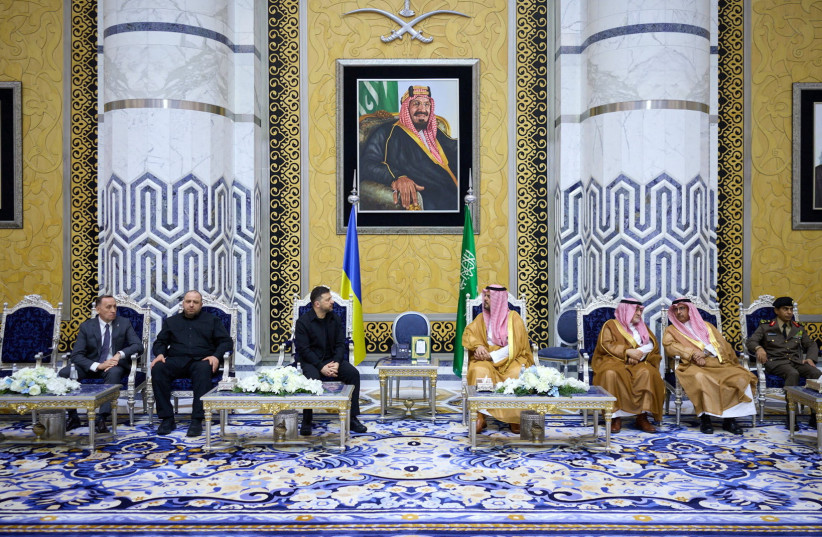
Ukrainian President Volodymyr Zelensky traveled to the Middle East over the weekend as part of an important initiative to share experience with the Gulf states.
Since the Iran war began on February 28, the Gulf states have been heavily bombarded by Iranian drones and missiles. Ukraine has long experienced being under similar types of attack.
Iran supplied Russia with the Shahed 136 drone that Moscow has used thousands of times to attack Ukraine. As such, Ukraine and the Gulf states are now at the front line of the drone war, and they are both impacted by the Russia-Iran partnership.
Zelensky held key meetings in the UAE, Saudi Arabia, and Qatar, showing how countries linked to the US and the West can work together. It also raises questions about why the US views these wars as separate, seeing Ukraine as a European problem, but seeing Iran as a US problem.
Recent statements from the White House and US officials have been critical of the European approach and of NATO. NATO is inherently a defensive alliance, yet it is being portrayed by the US more as an alliance that owes the US support for the war of choice that was launched on February 28.
Gulf outreach shows Ukraine exporting drone defense amid Iran war
Zelensky’s visit to the region is therefore symbolic. He was received warmly – more so than at the first meeting he had with the Trump administration last year – importantly showing that there is a model in which Ukraine could be seen in a more positive light, if only its conflict were seen as linked to Iran by those who oppose Iran.
The Gulf states understand this and see Ukraine as a friend. Israel has not shown Zelensky the same warmth he has received in the Gulf, even though Israel and Ukraine have been under Iranian drone threats.
“For several weeks now, Ukrainians have been working here to help in protecting lives,” Zelensky wrote on X/Twitter. “I met with members of our team here and discussed the initial results, the key conclusions from their work in the Emirates, as well as several proposals.”
“Our shared goal with our partners is greater security,” he said. “Ukrainians, unfortunately, remember well what it was like when Russia’s full-scale aggression against our country began. Much depended on fast and effective defense decisions. Today, Ukraine not only needs assistance but is also ready to support those who support us.”
Zelensky met with UAE President Sheikh Mohamed bin Zayed al-Nahyan.
“Terror must not prevail anywhere in the world,” he wrote on X. “Protection must be sufficient everywhere. That is why we are open to joint work that, in a strategic perspective, will certainly strengthen our peoples and the protection of life in our countries.”
“Ukraine has relevant expertise in this area – our cities, unfortunately, have been under daily attack for four years of full-scale war,” Zelensky said. “Ukrainians have developed an appropriate protection system that delivers a significant interception rate against enemy drones and missiles. This systematic approach and integration of experience is exactly what we are offering to our partners.”
Saudi Arabia-based newspaper Arab News reported: “Saudi Arabia’s Ministry of Defense signed a memorandum of understanding with Ukraine on Friday covering defense procurement arrangements.”
Meanwhile, there are other major issues developing in the region. A month into the war, the “United States can only determine with certainty that it has destroyed about a third of Iran’s vast missile arsenal as the US and Israeli war on the country nears its one-month mark, according to five people familiar with the US intelligence,” Arab News reported.
The Houthis have also joined the war now, targeting Israel. It appears they will initially target Israel, but this could escalate the war in general.
The UAE continues to intercept missiles and be threatened by Iran. Israel continues its airstrikes against Iran and Lebanon, even as the war’s next steps remain unclear.
The Ukraine meetings have wider ramifications. The deals that Zelensky is working on can lead to decades of cooperation, and this will boost Ukrainian security and economy, as well as the Gulf states.
The meetings take place as the Group of Seven discusses Iran and Ukraine. The US has appeared to be tough on the EU, however, portraying the Ukraine conflict as a European issue.
“EU foreign policy chief Kaja Kallas asked Secretary of State Marco Rubio when the US would get tough on Russia during a G7 ministers meeting on Friday, sparking a sharp retort, according to three sources who attended the meeting,” Axios reported.
France24 reported: “European foreign ministers on Friday used a G7 meeting with US Secretary of State Marco Rubio to press the case that Russia was helping Iran target US forces in the Middle East war. Rubio joined the second day of the gathering of ministers of leading Western democracies, taking place amid wars in Iran and Ukraine, economic
uncertainty and mounting unease over unpredictable US foreign policy under [President] Donald Trump.”
This comes amid tensions between the White House and NATO.
For Russia and China, these disputes are welcome news. They want a multipolar world. The US national-security strategy in 2017 envisioned the US confronting Russia and China. Today, with the US fighting in Iran, the next stage is unclear.
This is one reason why Ukraine and the Gulf states are embracing each other. They want clarity in a changing multipolar world.