
Brig.-Gen. Rahman Moghaddam, the commander of the Islamic Revolutionary Guard Corps (IRGC)'s special operations unit, Unit 4000, began planning operations in the Strait of Malacca and the Bangka Strait, two waterways essential to global trade, and ports in Indonesia and China, Iran International reported on Tuesday, citing several informed sources.
Moghaddam was previously believed to have been killed during Israeli strikes on March 4. The day after reports of his death were published by Israeli media, two drones were launched by Iran towards Azerbaijan. The strikes were reported by CNN to be in retaliation for Moghaddam's killing in an attack believed to have been carried out from Azerbaijani territory.
Informed sources have told Iran International that Moghaddam survived the attack and commands Unit 4000, heading a unit responsible for assassinations and sabotage operations against Iran's opponents outside its borders.
IRGC recruits operatives in East Asia
The IRGC began recruiting non-Iranian operatives long ago to facilitate maritime terrorism operations in East Asia, allowing it to deny responsibility if operations were exposed, according to Iran International.
Moghaddam sought to recruit non-Iranian Shi'ite operatives in Thailand through Seyed Momen Saketicha, a senior figure in the Thai Shi'ite community. Saketicha participated in negotiations with Hamas in Tehran two years ago over the release of 31 Thai hostages held in Gaza.
Iran attempted to pressure Thailand into removing 40,000 Thai workers from Israel in exchange for the hostages' release.
In addition to attempting to recruit Thai operatives, Unit 4000 focused its attention on Indonesia, with Moghaddam using two Indonesian clerics to help recruitment, according to Iran International's report.
Three Unit 4000 recruits from Indonesia have been allegedly hired to carry out maritime sabotage operations in East Asia.
Iran threatens to expand war into Indian Ocean, Mediterranean Sea
Two months ago, Mohsen Rezaei, adviser to Iran's Supreme Leader Mojtaba Khamenei and secretary of Iran's Supreme National Security Council, told CNN that if the war and US naval blockade were not lifted, Iran would expand the war into the Indian Ocean and the Mediterranean Sea.
IRGC Quds Force commander Brig.-Gen. Esmail Qaani said in a televised interview that the IRGC had additional maritime targets beyond the Strait of Hormuz and Bab al-Mandeb.
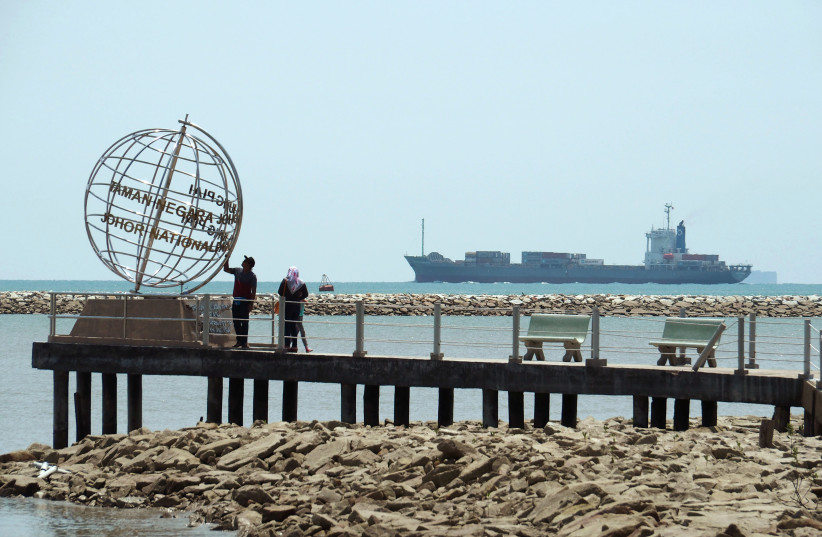
The Strait of Malacca has been repeatedly raised in discussions of the oil trade in recent months. As the shortest maritime route between Middle Eastern energy exporters and East Asian markets, roughly 29% of global seaborne oil trade passed through the strait during the first half of 2025.
Disruptions in Hormuz and Malacca would put pressure on two major energy supply routes from the Middle East to Asia.
While the Bangka Strait, located between Sumatra and Indonesia's Bangka Island, does not have the same global importance as Malacca, it forms part of the region's shipping network. An interruption there could intensify pressure caused by any potential disruption in Malacca.
Iran's target list also includes Tanjung Priok Port in Indonesia and the Ningbo Zhoushan and Shanghai ports in China, according to Iran International.
Hezbollah member Pando Yudahvinata, who was expelled from an Indonesian university before traveling to Tehran and being recruited by security organizations, is one of the three operatives the IRGC has hired, Iran International wrote. Yudahvinata was responsible for a failed suicide attack against the Israeli Embassy in Bangkok 32 years ago. His name has also been linked to a series of bombings in Sri Lanka.
He and two other Indonesian citizens, Ardianta Mutoha and Mohammad Hossein, traveled to Tehran for training to prepare for covert operations at ports and waterways in East Asia, according to the report.