
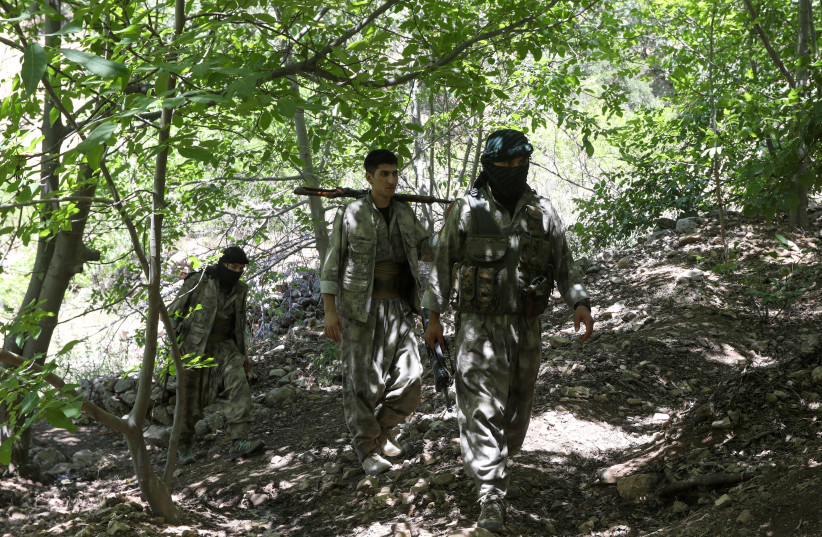
The Kurdistan Freedom Party (PAK) said one of its headquarters was targeted in the Kurdistan Region of northern Iraq on Tuesday night. PAK is one of several Kurdish Iranian opposition groups.
“At 23:45 tonight, a drone attack targeting the bases of the Kurdistan National Army by the Iranian Regime was intercepted,” PAK reported.
It was the latest attack against Kurdish Iranian opposition groups over the past few days. Komala factions of Iranian Kurdish separatist groups have also been targeted at least two times over the past week.
The attacks are taking place as the US withdraws from Iraq in accordance with an agreement for US-led, anti-ISIS coalition troops to leave.
They also come after Iran has targeted US diplomatic posts in Iraq since February, according to a new US Inspector General Report.
“Mission Iraq experienced more than 600 attacks during the reporting period,” the report said. “The US Consulate General in Erbil’s new consulate compound suffered damage to multiple buildings. The US Embassy in Baghdad suffered damage but to a lesser extent. The Baghdad Diplomatic Support Compound, located near Baghdad International Airport, suffered extensive damage.”
To provide some background, Iranian Kurdish opposition groups have sought greater political and military coordination during 2026. Unrest inside Iran and the wider conflict involving Iran has created new opportunities, and new risks, for parties that have opposed Tehran for decades.
On February 22, days before the US and Israeli airstrikes against Iran, five groups announced the Coalition of Political Forces of Iranian Kurdistan. The founding members were the Democratic Party of Iranian Kurdistan (PDKI), Kurdistan Freedom Party (PAK), Kurdistan Free Life Party (PJAK), Organization of Iranian Kurdistan Struggle (known as Khabat), and Komala of the Toilers of Kurdistan.
The Komala Party of Iranian Kurdistan subsequently joined, creating a six-party alliance. The coalition said its objectives included replacing the Islamic Republic, Kurdish self-determination, and establishing democratic governance. Komala has three branches. Ultimately, two of them joined.
Iran targets Kurdish opposition groups amid regional power struggle
Iran has lashed out and struck these groups. Tehran knows there were reports that the US wanted to arm these groups. It also suspects Israel supported them with airstrikes.
Over the past several years, Iran has targeted the autonomous Kurdistan Region of northern Iraq, claiming Israel is active there. Tehran has sought to spread the war there and create a front line, suspecting that this is a kind of soft underbelly.
While the US has power in the Gulf states and other areas, Iran is seeking to push the US and its partners out of the region. The Kurds are seen as partners of the US. Iran also struck US bases and hopes the US will reduce its forces, weakening Iraq, Kuwait, and other countries.
What should we know about the Kurdish Iranian opposition alliance? The alliance brought together organizations with different histories and ideological backgrounds.
PDKI and the various Komala factions have operated for decades, while PAK emerged later as an armed Kurdish nationalist organization. PJAK, which has links to the broader movement associated with the PKK, maintains forces in mountainous areas along the Iran-Iraq frontier.
The groups had already increased coordination during anti-government protests in January, when seven Kurdish parties backed a general strike across Kurdish areas of Iran.
Kurdish opposition groups face wave of Iranian attacks
Iran has responded by increasing attacks on the groups, particularly those with camps in the autonomous Kurdistan Region of Iraq. Iranian missiles and drones have repeatedly targeted facilities associated with PDKI, Komala, PAK, and other opposition organizations.
According to a UK government review, citing reporting from the region, almost 700 Iranian and Iran-linked missile and drone attacks targeted Iraqi Kurdistan between February 28 and mid-April, including about 170 strikes directed specifically at Iranian Kurdish opposition parties. It is now believed there have been 1,000 attacks.
Iran renewed strikes against Komala facilities near Erbil in July, August, and early September. The attack on PAK illustrates how Tehran intends to maintain its attacks.
This is taking place as Iranian-backed militias in Iraq refuse to disarm and also target Saudi Arabia.