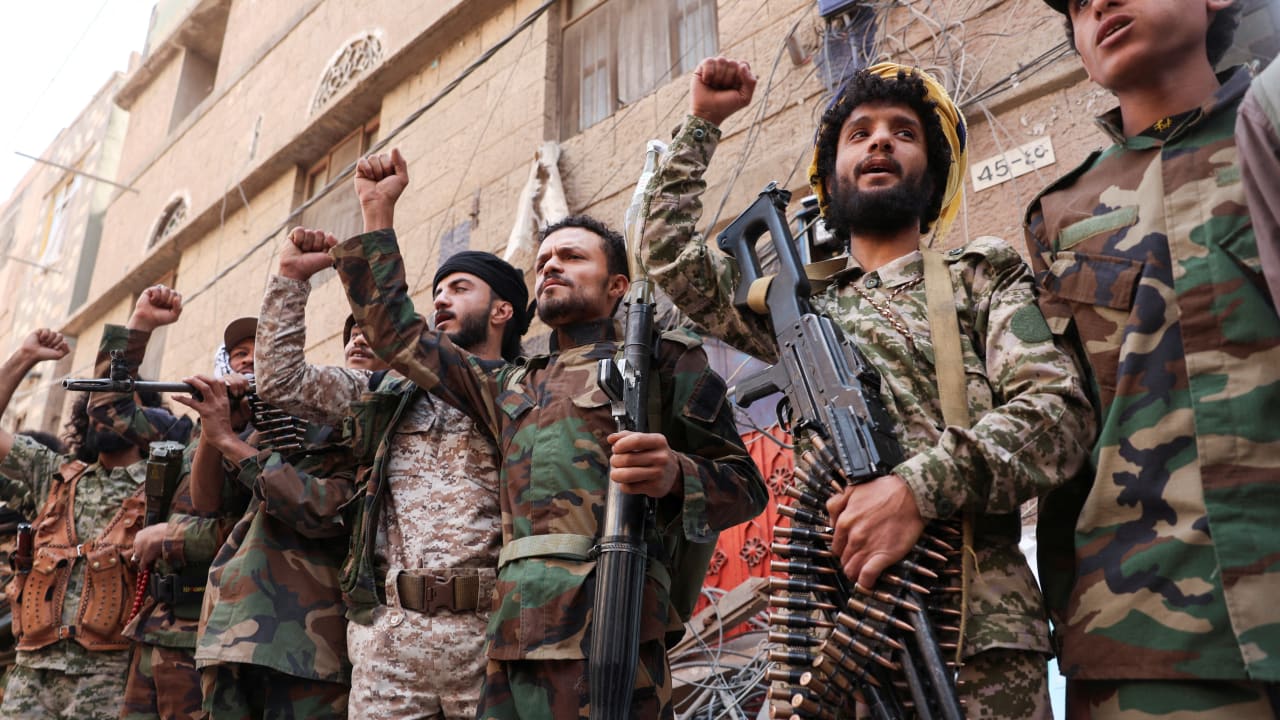
The Houthis continue to attack Saudi Arabia. They are also still engaging in fierce battles in Yemen. Talks with Iran – which appear to be underway – will have to take the Houthis into account. Arab News in Saudi Arabia wrote on Friday that “a drone launched by the terrorist Houthi militia has been intercepted and destroyed in the Makkah region” by the Saudi-led coalition, according to Riyadh.
The report noted that “the Iran-backed militia has for weeks targeted airports, energy infrastructure, and cities across the kingdom with drones and missiles.”
Al-Ain media in the United Arab Emirates added that “dozens of government forces and Houthis were killed and wounded on Friday in fierce battles in Al-Maqatra district of Lahj, following a large-scale attack by the militias.”
Sources in Yemen told Al-Ain that the Houthi militias had launched a large-scale ground attack on government forces’ positions in Al-Maqatirah district, the northern gateway to Lahj, in an attempt to make progress toward controlling key mountain ranges in the area.
This is an area in southern Yemen where the Houthis have been fighting a tough and complex war against the government of Yemen and aligned factions, some of which are linked to the UAE-backed Southern Transitional Council.

The UAE has excellent sources in this area. They confirmed that the aim of the Houthi attack was to control the Maqatirah Tunnel area and the strategically important Al-Maqatirah mountain fortress “and to reach the “Al-Rubu” market located in the Heijah Al-Abd valley, where the main road linking Taiz and Aden is located.”
The sources explained that the battles extend to the Haifan front, where the militias are trying to reach Mount An’an, which overlooks large areas between Haifan and Al-Maqatirah.
Events in Yemen could affect Iran, UAE, Qatar, US
The Iran-backed Houthis have emerged as one of the most important armed terrorist armies in the Middle East, using Yemen as a base to threaten Saudi Arabia, Israel, and international shipping. The movement, also known as Ansar Allah, emerged from northern Yemen’s Zaydi Shi’ite community and seized the capital, Sanaa, in 2014.
In early 2015, Houthi forces advanced south toward Aden, forcing Yemen’s internationally recognized government to flee. Saudi Arabia intervened in March that year, at the head of an Arab coalition seeking to restore the government and prevent the Houthis from consolidating control over Yemen.
The war devastated the country but failed to defeat the Houthis.
Iran’s support helped the movement to develop an increasingly sophisticated arsenal of ballistic missiles, cruise missiles, and drones. These weapons enabled the Houthis to strike Saudi Arabia and eventually target Israel.
Following the Hamas attack on Israel on October 7, 2023, the Houthis began launching missiles and drones toward Israel and attacking commercial shipping in the Red Sea.
Israel, the United States and Britain subsequently carried out strikes on Houthi targets. In turn, they resumed attacks on Israel during the 2026 war with Iran.
Yemen’s war escalated again in July, when the Houthis renewed attacks on Saudi targets and shipping.
In September, Houthi forces advanced along the Red Sea coast, capturing the port city of Mocha and reaching the strategically important Bab el-Mandeb Strait. The strait connects the Red Sea to the Gulf of Aden and is a vital route for international trade and energy shipments.
Fighting has also intensified around Taiz, where the Houthis have sought to threaten the road linking the city to Aden, the internationally recognized main base of the Yemen government.
The renewed conflict illustrates how Yemen’s civil war has become intertwined with the wider regional confrontation involving Iran, Saudi Arabia, and Israel. Control of territory around Bab el-Mandeb gives the Houthis additional leverage over regional security and international commerce.
Al-Ain said that as the battles in the mountains have continued, “warplanes launched a series of raids on Houthi positions and gatherings to repel the militia’s attack on Al-Maqatirah district in Lahj governorate.”
Al-Ain reported that “by attacking Al-Maqatirah, the Houthi militias are trying to reach Tur Al-Bahah district in Lahj, a coastal province that is the main gateway to the capital, Aden.”
Yemen has been witnessing fierce battles since the beginning of September 2025, following a large-scale, multi-pronged attack launched by the Houthis on areas of the western coast, Bab el-Mandeb and Taiz, which resulted in thousands of deaths and injuries.
Houthis lay seige to Taiz
The Houthis are also laying siege to the city of Taiz in the mountains. Arab News said that the Houthis are also facing growing international criticism over their detention of United Nations personnel and the worsening humanitarian crisis in Taiz, Yemen’s third-largest city.
According to Arab News, the Houthis are holding 71 UN staff members, severely restricting the organization’s ability to operate in areas under their control. “These actions render the delivery of humanitarian aid in areas under the control of the Houthis untenable at this time,” Shirin Yaseen, associate spokesperson for UN Secretary-General Antonio Guterres, told Arab News.
The reports indicated that the humanitarian situation has further deteriorated around Taiz, where more than 800,000 people have been cut off from essential supplies.
The Houthis intensified their siege in early October after seizing the road connecting Taiz with Aden, the seat of Yemen’s internationally recognized government.
According to the UN’s World Food Programme, approximately three-quarters of the affected population depend on humanitarian assistance. Taiz has faced varying degrees of Houthi siege since 2015.