
US Central Command (CENTCOM) has highlighted the extensive military assets being used to enforce the American blockade of Iranian ports, illustrating the scale of Washington’s effort to isolate Iran while maintaining freedom of navigation through the Strait of Hormuz. On Wednesday, it reported that “forces continue to strictly enforce the US blockade against Iran. ... CENTCOM has redirected 20 commercial vessels, disabled two, and boarded two.”
A new CENTCOM graphic describes the operation as the “US blockade of Iranian ports” and emphasizes an important part of the operation. Ships are not permitted to enter or leave Iranian ports, and the blockade is being applied to vessels regardless of nationality. However, other commercial vessels have freedom of navigation to transit the strait. Freedom of navigation of the oceans has been a key US foreign policy goal for over a century.
The blockade of Iranian ports involves a wide variety of American military capabilities. CENTCOM’s graphic highlights aircraft carriers, guided-missile destroyers, and intelligence, surveillance, and reconnaissance drones.
Fixed-wing aircraft, such as F-35s and F-15s operating from land and sea, are also involved, along with military helicopters and embarked US Marines trained for maritime interdiction operations.
TWZ digital media noted that “both carriers deployed to the CENTCOM area of responsibility, USS Abraham Lincoln and USS George H.W. Bush, remain on station ‘to support maritime security and stability in the Middle East.’”
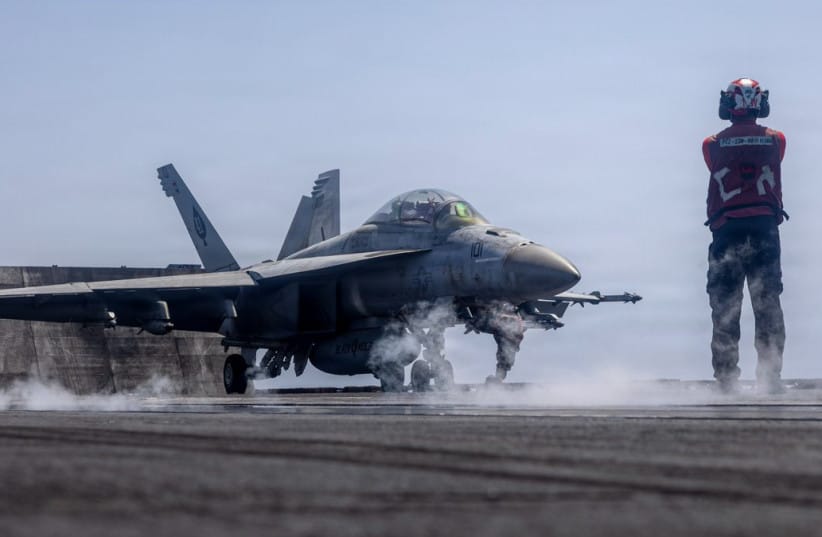
US maintains broad military capabilities in Iran blockade
This means the United States has assembled the types of capabilities necessary not only to track vessels but also, potentially, to intercept them. Aircraft carriers provide maritime airpower, while destroyers can provide air and missile defense as well as aid with surveillance.
Large drones can maintain awareness over large areas, helping identify and track vessels approaching Iran. Some drones also carry munitions, such as MQ-9 Reapers, while the Global Hawk is a large drone that only carries out very high-level surveillance.
The US Marines provide another important element. Their presence gives commanders personnel trained to conduct maritime operations if vessels need to be stopped or boarded. They can also be used on-shore for raids or for so-called Littoral operations.
The blockade is part of the wider US military campaign against Iran. CENTCOM launched Operation Epic Fury on February 28.
By early April, the US said the operation had employed an extensive number of American systems and platforms, including aircraft carriers, destroyers, submarines, F-15s, F-18s, F-22s, F-35s, electronic warfare aircraft, reconnaissance platforms, and MQ-9 Reaper drones. A-10s had also been used.
US resumes blockade after Iran violates Memorandum of Understanding
Washington initially imposed a blockade of Iranian ports in April. CENTCOM said at the time that more than 10,000 personnel and over a dozen warships were involved, emphasizing that vessels not traveling to or from Iranian ports could continue through the Strait of Hormuz
The blockade was temporarily lifted in June as part of a US-Iran memorandum of understanding (MoU). Iran then carried out attacks, and the US imposed the blockade again.
This is important because Hormuz remains at the center of the conflict. Current diplomatic efforts involving Oman and other countries are focused on restoring freedom of navigation. Iran has sought a larger role in controlling traffic through the strategic strait, using tolls or other methods.
The American goal is that Iran be unable to disrupt international shipping while continuing to benefit from its own maritime trade. Also, the main US goal is to prevent Iran from acquiring a nuclear weapon. The combination of naval, air, surveillance, and marine assets gives CENTCOM the capabilities to enforce that policy across Iran’s long coastline.
However, new tensions in Iraq and the report of an attack on the coast of Egypt raise concerns that the conflict is expanding. Iran has spread threats over thousands of miles in the region.