
With a Paris peace conference looming, France’s president has found a convenient scapegoat.
France is preparing to host an international conference on the two-state solution next month. Fine. But the way Paris has chosen to frame this conflict in the run-up – who gets cast as the obstacle, who gets cast as the victim – does not suggest neutrality. It’s politics masquerading as diplomacy.
Take the language. On April 28, on BFM TV, French Minister of the Armed Forces Catherine Vautrin declared that “France cannot accept either Hezbollah or the IDF – that is the heart of the matter.”
Vautrin added that “both sides have attitudes that are unacceptable.” It speaks of Hezbollah rocket fire and Israel’s response in the same breath, as though they occupy the same moral register.
The French Foreign Ministry – the Quai d’Orsay – uses this grammar of equivalence routinely: “all parties,” “de-escalation,” the full lexicon of even-handedness. It sounds reasonable, but it isn’t.
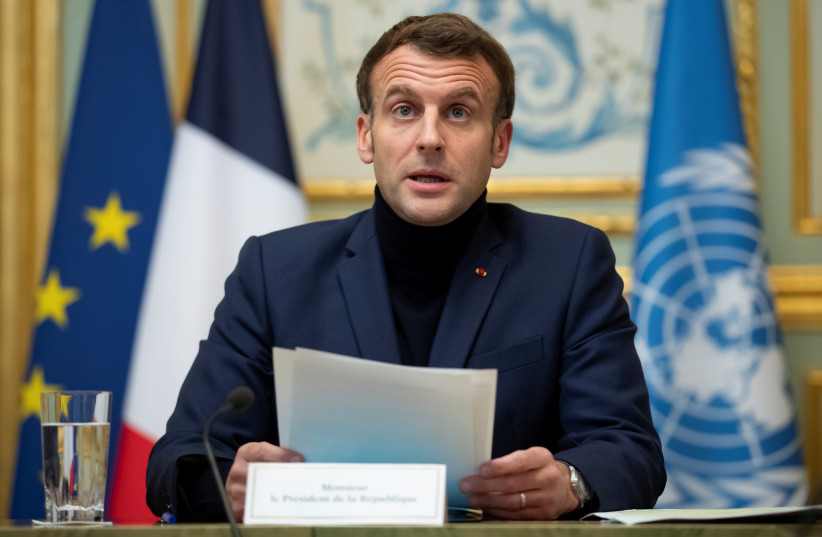
Double standards applied to Israel
The conflation of a sovereign democracy and a militia whose military wing the European Union itself, France included, classifies as a terrorist organization. That’s not neutrality.
Then there’s the Christian angle, which French President Emmanuel Macron has pursued with what can only be described as unusual vigor. The blocked access to the Church of the Holy Sepulchre on Palm Sunday.
The assault on a nun in Jerusalem’s Old City. The desecration of a Crucifix in Lebanon. These incidents are real. They deserve condemnation, and I condemn them here, fully.
But consider this. On April 29, 2026, the cathedral of Stepanakert was razed in Nagorno-Karabakh, Azerbaijan.
Not damaged – razed. In Nigeria, Burkina Faso, and the Democratic Republic of Congo, jihadist attacks on Christian communities continue on a scale that makes anything occurring under Israeli administration look, by comparison, minor.
France’s response to those situations has been, to be charitable about it, muted. Very muted.
The disparity is too consistent to be accidental, and too politically convenient to ignore.
There is also a factual problem. Macron recently said that Israel was “created by a UN decision.” This is wrong, and wrong in a way that has consequences. UN Resolution 181 – adopted in 1947 – recommended a partition plan. It did not create Israel.
The State of Israel was proclaimed in May 1948, based on Jewish historical connection to the land and the internationally recognized right to self-determination. Why does the distinction matter?
Because framing Israel as a product of institutional decision-making implies, at least to those who want to hear it, that institutional decision-making could one day unmake it. I’m not saying that’s the intention, but it is the effect.
Now, back to the June conference. In theory: a peace initiative. In practice: a theatrical production. No credible Palestinian partner will be at the table.
There is an active war. The two-state solution, whatever one thinks of it as an eventual horizon, is not an agenda item that a conference in Paris can advance under these circumstances.
It can, however, generate headlines – positioning France and its president as engaged, relevant, constructive. Performative concern about peace is not actual concern about peace, even when it cribs its vocabulary.
I’ve spent years working on European engagement with Jewish communities and with Israel, and one thing I have learned is how much context matters in the way European leaders talk about this conflict.
France’s context today is that it has been effectively expelled from the Sahel. Its leverage in Lebanon runs through Washington, not Paris.
A country that has lost its footing in its own traditional sphere of influence does not have the credibility to play the role of the architect of peace in the Middle East. What it can do is find a stage. And stages need stories with heroes and villains.
Macron is entitled to his foreign policy. France is entitled to its priorities. But Israel is also entitled to say plainly what it sees. And what it currently sees is French diplomatic posturing that consistently assigns it the role of impediment.
And this by a government whose actual leverage in the region has largely evaporated. Diplomacy in search of a culprit will always find one. Israel, at this point, is hardly shocked to discover it has been assigned the part.
The writer is a senior fellow at the Jewish People Policy Institute (JPPI), where he heads its European activities.