
This is the season, it seems, of political bombshells.
If US President Donald Trump’s announcement Tuesday that he was ending military aid to Israel by year’s end did not knock you off your chair, Yisrael Beiteinu leader Avigdor Liberman’s willingness to compromise on haredi (ultra-Orthodox) conscription to bring the ultra-Orthodox parties into a Gadi Eisenkot government surely must have.
Liberman, who has spent years building his political persona around confronting those parties?
Liberman, who in 2019 prevented Prime Minister Benjamin Netanyahu from forming a government and threw the country into a spiral of elections because of his refusal to compromise on haredi conscription?
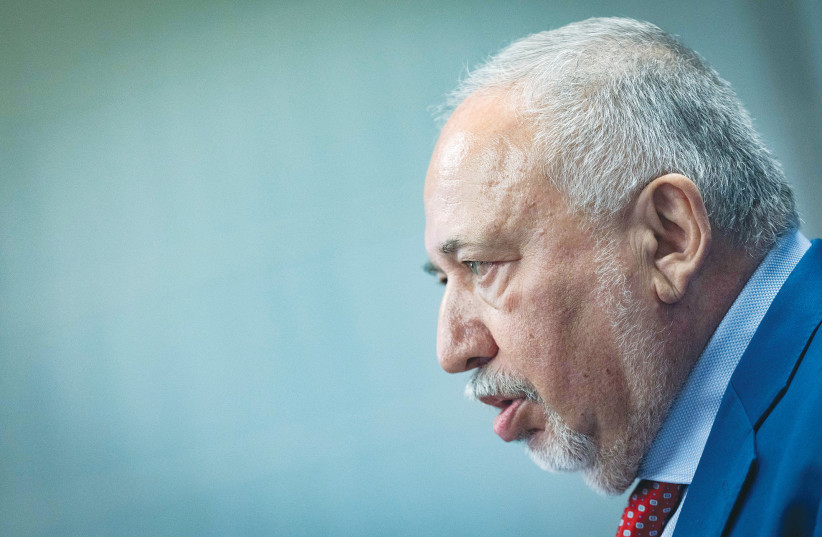
Liberman, who suggested denying the vote to those who evade military duty? Liberman, whose campaign slogan promised 100% to those who serve and zero to those who evade?
That Liberman? Avigdor Liberman?
Is he now prepared to give the ultra-Orthodox parties the power to make or break an Eisenkot-led government?
Allowing haredi parties to veto meaningful conscription would extinguish hope of solving issue
If the price is allowing those parties to veto meaningful conscription, such a move would extinguish any realistic hope of getting the ultra-Orthodox to carry their fair share of the security burden.
The election dealt the country a difficult hand. Anyone hoping to assemble a government will have to compromise.
If every party insists on every campaign promise, no workable coalition will form for years. But haredi conscription was more than just another Liberman campaign promise.
Some voters chose Yisrael Beytenu precisely because they believed he would be the last politician to surrender on an issue with profound implications for national security and solidarity.
Nor was this Liberman’s cause alone.
The change bloc repeatedly attacked Netanyahu’s reliance on parties that defended draft evasion. Naftali Bennett hammered the point home. Eisenkot made service for all one of the four principles prospective coalition partners would have to accept.
This was not some incidental campaign pledge. It was central to the bloc’s – and to Liberman’s – identity.
Compromise on coalition partners is one thing. If Liberman now recognizes that he cannot indefinitely exclude parties representing a significant part of the population, that is commendable. Compromise that preserves the current grossly unequal distribution of the security burden is something else entirely.
Drafting haredim is not a slogan. It is an urgent operational necessity. The IDF has reported a shortage of some 12,000 soldiers, including up to 7,500 combat troops. Without more recruits, the burden falls back on the same reservists, their families, and their employers.
These people cannot keep putting their jobs on hold, absorbing lost income, and leaving their spouses to raise their children alone for long stretches. Another coalition agreement that protects exemptions will exact a painfully concrete price from reservists and their families.
Repackaging exemptions no different than capitulation
The test is simple: Will an agreement bring additional soldiers into the army within a meaningful timetable, with consequences for failing to meet it? If it merely repackages exemptions, it is capitulation, no matter how Liberman wants to package it.
Liberman’s enmity toward Netanyahu is legendary. But if the price of replacing Netanyahu is leaving the same reservists and their families to shoulder the same intolerable burden, what kind of change is Liberman offering?
There is another way: an emergency unity government comprising Likud, Yashar, B’Yachad, and Yisrael Beytenu, without the ultra-Orthodox parties, the Arab parties, or the extremes on either side.
Such a government would have the parliamentary strength to address both haredi conscription and judicial reform without giving parties opposed to compromise a veto.
Agreement would hardly be automatic. But there would at least be a realistic chance of resolving issues that narrower governments remain structurally incapable of settling.
We are at the beginning of the coalition negotiations and over the next few weeks positions will shift, trial balloons will float, and declarations will be made that should be taken with a grain of salt.
But there must be a boundary. A government in which the haredi parties can torpedo meaningful conscription must be a nonstarter.
Flexibility cannot become a respectable word for abandoning the people whose service makes coalition negotiations possible.
Otherwise, politicians will only deepen the public’s cynicism and corrosive conviction that nothing said before an election – even a party’s primary message – matters afterward at all.