
The anniversary of the passing of the Maharal of Prague falls on 18 Elul, which this year is August 31. This is an opportunity for Jewish travelers to visit the city where his name still seems to hover among the pointed rooftops.
Over four hundred years have passed since his death in 1609, yet in Prague, time is a flexible substance. It clings to the stones, becomes trapped between the vaulted ceilings of the synagogues, and hides in the cracks between the ancient tombstones.
Prague is beautiful. In the morning, it awakens from a thin mist rising from the Vltava River, bells ring above the rooftops, and red trams squeal along the tracks.
Czechia is considered one of the most Israel-friendly countries in Europe, and Prague gives Jewish travelers a relatively pleasant and safe feeling. While in various European destinations we are required to exercise greater caution in the face of antisemitism, on the streets of Prague I felt free to walk around even with my kippah and tzitzit openly visible.
But the deeper connection between Prague and the Jews cannot be measured by political declarations. You have to walk to the old Jewish Quarter, Josefov, and open a heavy door there.
The Altneuschul
The “Old-New Synagogue” is one of those places where it seems that history did not end, but merely took a short break. It is the oldest synagogue in Europe that is still active. It was built in 1270 and has served the community for more than 700 years.
Legend has it that stones from the ruins of the Temple in Jerusalem were incorporated into the foundations of the Altneuschul, giving rise to the interpretation that its name derives from the Hebrew words meaning “on condition,” referring to the condition that the stones would one day be taken to Jerusalem when the Messiah comes.
But the truth is less poetic. “Alt-neu” means “old-new.” At first, it was called “The New Synagogue.” Over the course of history, additional synagogues were built in the Jewish Quarter, and one of them proudly bore the name “New.” To distinguish between the two synagogues, the word “Old” was added to the name of the older one, hence the name “Old-New.”
The stone floor is lower than the entrance. Overhead rise six Gothic vaults, light filters sparingly through twelve windows, and the entire hall is steeped in that dignified dimness found in places where generations have whispered the same prayers.
The Holy Ark on the eastern wall is made of marble, and above it is a pointed arch with stone decorations. Next to the Holy Ark stands the “Maharal’s Chair,” and care is taken that no one sits on it.
In the center of the synagogue is a raised bimah with a table for reading the Torah, surrounded by iron railings. Above them flies the flag of the Jewish community dating from the 17th century. It is a red flag embroidered with a yellow Star of David, with a Jewish hat at its center. The flag also has an embroidered yellow border, at the top of which are the words “Shema Yisrael.”
And above it all is the attic. There, Prague whispers, lies the Golem.
Here the Maharal prayed and taught. Rabbi Judah Loew ben Bezalel was much more than the city’s chief rabbi. Alongside his extensive knowledge of the Talmud and Midrash, he also studied philosophy and the sciences and wrote dozens of books.
Rabbi Abraham Isaac Kook wrote that the Maharal had “redeemed” the teachings of Kabbalah from their concealment and made them accessible to the wider public. That is why most of us studied his book Netivot Olam in Yeshivot Bnei Akiva. I recommend packing it for a trip to Prague so that you can return to reading it here as well.
The Golem that never left Prague
The Maharal is probably the best-known Jewish rabbi today, even among Christians, and that is because of the story of the Golem. According to legend, when the Jews of Prague suffered from blood libels and persecution, the Maharal created a human figure out of clay and breathed life into it. Something like a modern robot. The Maharal sent the Golem into the streets of Prague “to deal” with non-Jews who harassed Jews and with those who spread blood libels.
One Friday evening, the Maharal forgot to deactivate the Golem, and it went out into the street and began to run wild and cause damage. The Maharal was informed of this in the middle of the recitation of “Mizmor Shir” of the Kabbalat Shabbat prayer.
The Maharal immediately went out into the street, brought the Golem, and deactivated it. Afterwards, the rabbi returned to the synagogue and began reciting “Mizmor Shir” once again. Since then, to this very day, the custom at the Altneuschul has been to recite “Mizmor Shir” twice during the Friday Maariv service. It is the only place in the world where this custom is observed.
The story of the Golem of Prague has no reliable historical basis. But in Prague, sometimes the legend is stronger than the footnote. Figures of the Golem peer out from the windows of souvenir shops, made of clay and wood, and the story continues to walk the streets as though someone had forgotten to erase the letter that gives it life.
A statue of the Maharal stands at the corner of Prague’s New City Hall on Mariánské námestí, near the Jewish Quarter. In the entire world, only two rabbis are commemorated as part of a city’s mythology with public statues: the Maharal in Prague and the Rambam (Maimonides) in Córdoba, Spain.
The synagogues of Prague
Several other synagogues remain in the Josefov Quarter, all within a short walking distance of one another. One of them, the Pinkas Synagogue, now serves as a Holocaust museum. Of the original synagogue, only the Holy Ark and the Torah-reading bimah remain. The names of 77,297 Jews from Bohemia who were murdered in the Holocaust are inscribed on the walls.
A walking path leads from the Pinkas Synagogue along the Old Jewish Cemetery. Here, the atmosphere changes.
Thousands of tombstones stand crowded together, leaning toward one another like old people wishing to whisper a secret. Among the graves is that of the Maharal.
Beside his tombstone, people leave notes and small stones. Some pray. Others simply stand. Perhaps this is the Maharal’s true power: not the Golem, but the fact that hundreds of years after his death, people still come to talk to him.
The Klausen Synagogue is the largest of the synagogues that remain from the old ghetto. It stands on the other side of the cemetery, in an area where houses of study established by Mordechai Maisel once operated and where the Maharal taught.
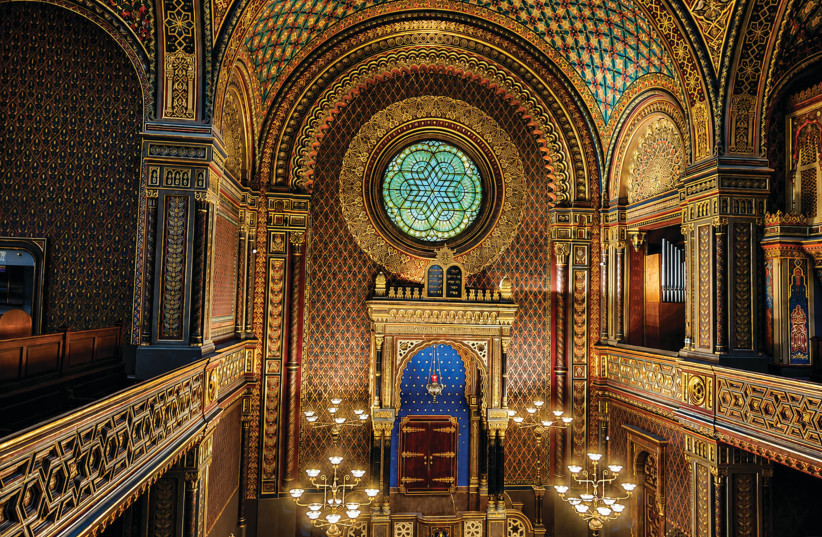
A Jewish itinerary in Prague should also include the Spanish Synagogue, built in the 19th century, whose rich Moorish design is reminiscent of the Alhambra Palace. Gold, arabesques, and geometric patterns make its interior one of the most impressive in the city.
The Maisel Synagogue was established by Mordechai Maisel, one of Prague’s wealthiest Jews and one of the community’s greatest benefactors during the Maharal’s time. Today, it houses an exhibition on the history of the Jews of Bohemia and Moravia, and among the exhibits are original writings of the Maharal.
A ticket office for admission to all the synagogues is located at Maiselova St. 38/15, opposite the Altneuschul. There is usually a long line there, so it is better to buy tickets online in advance.
Outside Josefov stands one of the most beautiful synagogues in the world, the Jerusalem Synagogue. After the gray stone and dimness of the Altneuschul, entering it feels almost like an explosion of color. The façade combines Moorish and Art Nouveau styles, with blue, red, and gold. Inside, colorful arches stretch overhead, Hebrew verses decorate the walls, and sunlight breaks through the stained-glass windows, painting the interior with color.
One Maharal against a hundred spires
Prague is a beautiful, romantic, and vibrant city with numerous opportunities for entertainment and sightseeing. Prague is also known as the “City of a Hundred Spires.” It is blessed with many tourist attractions that have no connection to Judaism. Here are a few recommendations:
Old Town Square is its beating heart. In front of the Astronomical Clock, tourists crowd together and raise their phones every hour on the hour.
From there, it is worth continuing to Charles Bridge, preferably early in the morning, when the stone is still cold, and the Vltava is silver-gray. In the first light, the statues gradually emerge from the darkness, and the spires on the far side of the river acquire edges of gold. In the center of the bridge, there is also a statue of a cross bearing the Hebrew words “Kadosh, Kadosh, Kadosh, Hashem Tzevaot” (“Holy, Holy, Holy is the Lord of Hosts”) written in gold.
Across the river rises Prague Castle, a vast complex of palaces, courtyards, and St. Vitus Cathedral.
You can cruise along the Vltava, lose yourself in the alleys of Malá Strana, or simply sit in a café and watch the trams pass by.
After a visit to Josefov, Prague looks different. Behind its Gothic and Baroque beauty lies another city, Jewish, ancient, and filled with memories, where the Maharal still seems to walk between the synagogue and the cemetery.
Perhaps that is why the Golem legend lives on: Prague itself is a little like a Golem, shaped from stone, clay, and memory, with a spirit that refuses to fade. Those who follow in the Maharal’s footsteps discover that sometimes the best way to know a city is to listen to the whispers beneath its towers.
The author is the creator of the JewishTraveler blog.