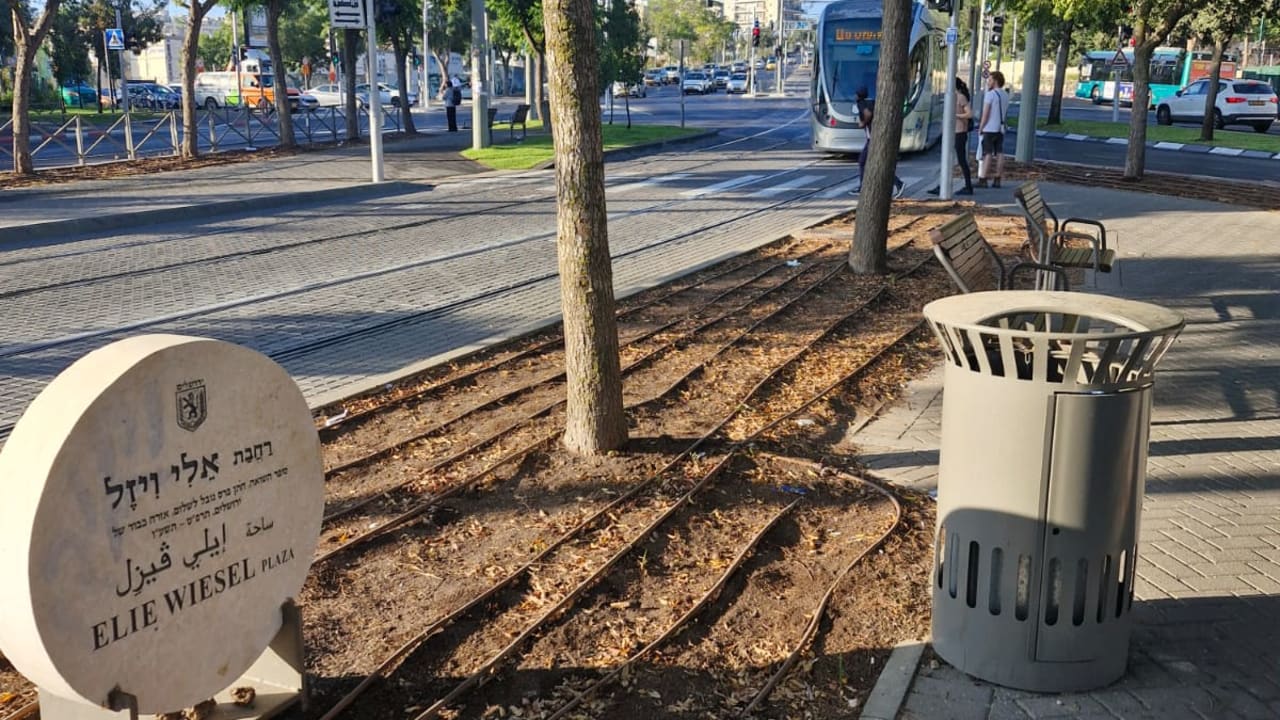
Residents of the Yefeh Nof and Beit Hakerem neighborhoods of Jerusalem near Mount Herzl were dismayed to see that the Elie Wiesel Plaza, south of the light rail station, had been destroyed during the week of Holocaust Remembrance Day.
The plaza, established more than five years ago and planted with hundreds of colorful annual flowering plants, was gone.
The round stone memorial disappeared over a year ago. It had been installed in memory of the Romanian-born American writer, professor, political activist, Nobel laureate, and survivor who had been a prisoner at Auschwitz and Buchenwald concentration camps during the Holocaust.
Calls at that time to the municipality spokesman and the 106 information number requesting an explanation for its disappearance were ignored. But now we understand why it was removed. The plaza’s garden was dug up.
The plaza’s demolition and the disappearance of the entire sidewalk adjacent to the southern part of Shmuel Beyth Street alongside the Shaare Zedek Medical Center (SZMC) were carried out to create a 130-m.-long underground pedestrian path that will end in a new entrance currently being constructed above the hospital’s underground parking lot.

Slated to take three years to complete at a cost of some NIS 73 million budgeted by the Transportation Ministry, the project was approved by the Jerusalem Municipality’s Finance Committee and is being implemented by the Moriah Jerusalem Development Company.
The hospital said that the tunnel, which will eventually house underground shops, was meant “especially for people with disabilities, the elderly, and people with strollers, including tens of thousands of patients, family members, and medical staff every day. Currently, access from the Yefeh Nof light rail station to the hospital requires crossing five pedestrian crossings and walking more than 300 meters, most of which is on a significant slope and narrow sidewalks.”
Project sparks debate over cost and necessity
The light rail’s Red Line goes to the entrance of Hadassah-University Medical Center in Ein Kerem; but to get from the station to the emergency room, inpatient departments, and outpatient clinics, one has to walk much farther than 300 meters.
Pedestrian access to Shaare Zedek’s entrance could have been achieved in another way instead of digging a tunnel. A horizontal escalator could have been constructed on the sidewalk of Beyth Street, opposite the hospital, with a glass cover to protect it from rain and cold – like at the airport. Then people could cross the pedestrian crossing to the hospital. No shops – but who needs more shops? There are enough.
The Jerusalem Municipality said in 2024 that the project “will create a convenient and accessible alternative for reaching the hospital, also via the city’s public transportation system, while eliminating the need to use a private vehicle. The municipality will continue to promote efficient transportation solutions for all road users and especially for users of public transportation in the city.”
Transport and Road Safety Minister Director-General Moshe Ben Zaken said: “Jerusalem continues to lead and innovate in the field of public transportation. We are now beginning to realize the vision of [Transportation] Minister Miri Regev to strengthen the connectivity of Jerusalem’s mass transportation system, which serves educational, medical, and cultural centers and connects them to employment and residential centers. I will work to promote the project as soon as possible towards its successful completion soon.”
SZMC’s director-general, Prof. Ofer Merin, commented that “this is important news for the residents of Jerusalem. Our hospital is the most accessible in the city and is located in the center of the city between the main traffic arteries: Begin Road and Road 16, and between two light rail lines – the Red Line and the future Green Line. Its location has made it the center to which most of the city’s emergencies are received.”
Merin told In Jerusalem that when construction is completed, he will make sure that the Elie Wiesel Plaza and its garden are restored.
One would hope that by then, the municipality will change its city-wide gardening policy and replace the flowering annuals planted by its gardening contractors with colorful perennials, as the current plants often dry out or are trampled within months. They are not replaced for another few months, although the earth is still watered daily before new flowers are replanted. This would be a significant cost-saving measure.