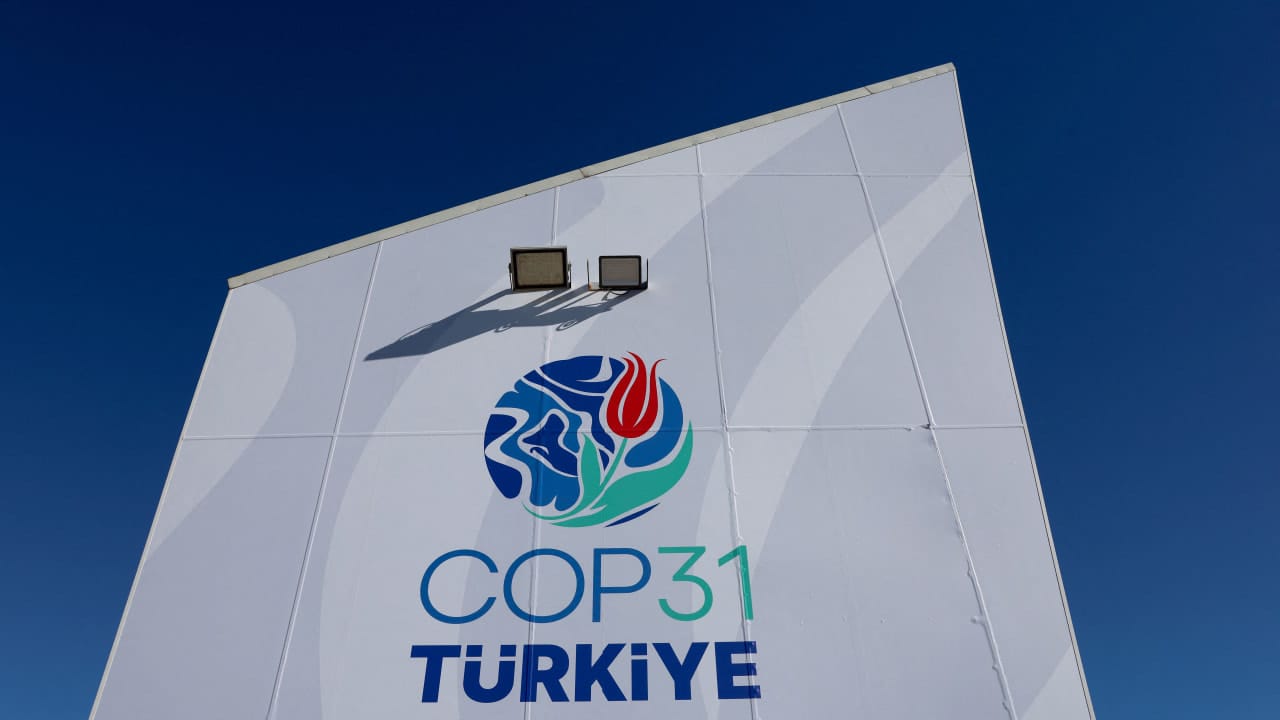
[ISTANBUL] United Nations climate talks in Antalya, Turkey, collapsed Sunday after Saudi Arabia and other oil producers forced every mention of oil, gas and coal out of the final text. It was the first time since 2009 that the yearly summit ended without a deal.
Egypt, North Africa and the Horn of Africa, among the regions most exposed to heat and water loss, went home with no new money to adapt. Saudi Arabia came away with a deal for its company ACWA Power to build 3,000 megawatts of wind farms in Turkey, the host, about a fifth of the country's current wind capacity. Saudi Energy Minister Prince Abdulaziz bin Salman signed it Nov. 10 with Turkish Energy Minister Alparslan Bayraktar as President Recep Tayyip Erdogan looked on. The UAE and Saudi Arabia split over how hard to push, and China sided with the producers.
"The UAE's international diplomatic propensity has now been about being a bridge-builder of sorts, and the kind of stark zero-sum assessments that the Saudis have been insisting on in the domain are not seen as being too effective within that model of diplomacy," Cauvery Ganapathy, a nonresident fellow at the Observer Research Foundation Middle East in Dubai, told The Media Line.
Gidon Bromberg, co-founder and Israel director of EcoPeace Middle East, a group that brings together Israeli, Jordanian and Palestinian environmentalists, said few governments saw a reason to lead. "There's no real sense of political urgency, and there's no real sense that 'I'm going to gain by showing my leadership on this issue,' particularly for those countries that will have to pay a heavy price," he told The Media Line. "It's not just the push of the oil-producing countries. It's the sense that they're going to have little to gain by showing leadership."
The United States sent no delegation for the second year in a row, and the White House called the talks "climate nonsense." About 130 countries signed a letter demanding language on moving away from fossil fuels. Mohammad Ayoub, the Saudi negotiator who spoke for the 22-member Arab Group, defended the text's support for capturing and storing carbon and rejected charges of greenwashing. "We believe that climate change requires all solutions on the table and that countries select from these solutions depending on their national circumstances," he told the closing session.

Turkish Environment Minister Murat Kurum, who presided over the summit, closed it without a deal. "Some countries got stuck on a single word or phrase and brought in issues that have nothing to do with climate, which unfortunately blocked progress," he told reporters.
Bromberg, who has attended climate summits for about a decade, compared Antalya with the 2023 talks in Dubai, where nearly 200 countries agreed for the first time to "transition away" from fossil fuels. "If I think of the Dubai COP, you had an oil-producing country taking leadership and wanting to show the rest of the world that this is not a zero-sum game, that we can really see ourselves as winners in fighting the climate crisis, because the investment in renewables is a profitable investment," he said. "In this particular COP, that's no longer the case."
The Antalya draft still referred to the Dubai agreement, known as the "UAE Consensus," by name. "Diplomatically, just the retention of the UAE Consensus in the present COP document should be seen as something that could again serve as a springboard for the next iteration," Ganapathy said. She said Saudi clean-energy efforts "had just begun to gain momentum when the present conflict's disruption upended many of their economic outlays and resource allocations."
Jaber Al-Shuaibi, an Emirati researcher, wrote in the Lebanese daily Annahar as the talks entered their final days that "the world knows where it should head to confront climate change, but it still disagrees over who bears the cost of the transition."
Turkish, Australian split presidency complicates COP31 negotiations
Turkey and Australia both bid to host. Turkey refused to withdraw, saying it had earned its turn after standing aside in 2021 for Glasgow, and a deadlock would have sent the talks to Bonn, Germany. Under the compromise, Turkey hosted and held the presidency while Australian Climate Change and Energy Minister Chris Bowen ran the negotiations. "The split presidency in Antalya was confusing to the parties," a former US official who followed the talks told The Media Line on condition of anonymity. "In Antalya they didn't have skin in a loss so could play hardball," he said of the Gulf producers.
"Dubai and Baku are examples of oil-producing countries that have led by example," Bromberg said. "Turkey's not an energy-producing country. It's an energy-buying country, like the rest of Europe. Is it more vulnerable to pressure from countries like Saudi Arabia? Perhaps."
"There's clearly a growing relationship between Saudi Arabia and Turkey that is public on the security side," he said. "To what extent that played in on this climate COP is still unknown."
The wind farms are the second phase of a 5,000-megawatt ACWA Power program in Turkey that began with 2,000 megawatts of solar in Sivas and Karaman provinces. ACWA Power Chairman Mohammad Abunayyan valued the full program at $4 billion to $5 billion and said in February that the wind phase would be signed by COP31. Bayraktar called the projects "one of the most important examples of direct foreign investment in our energy sector."
Defense ties are growing. In August, Turkey joined a Saudi-Pakistani mutual defense pact signed in Mecca, and Erdogan has said a Saudi investment in Kaan, Turkey's new fighter jet, "could be realized at any moment."
Israel skips COP31 amid tensions with Turkey, security concerns
Israel, a member of the UN climate convention, sent no delegation. Before the talks, Kurum said Turkey had not invited Israel to the leaders' summit. "We say that there can be no climate justice where peace does not prevail," he told Turkish media. Erdogan opened the summit saying that "Gaza has suffered not only genocide but also ecocide." Israel's Foreign Ministry accused him of using the summit to promote anti-Israel claims. An Israeli diplomat told The Media Line last month that Israel was entitled to join the negotiations but would stay away for security reasons.
In late August, a microalgae bloom that Israeli government scientists traced to the Nile Delta forced five of Israel's six coastal desalination plants to shut down, and they ran at reduced output for weeks. "What happened this summer is a real wake-up call for our region of the Eastern Mediterranean, first and foremost, but for the globe as a whole," Bromberg said. "It is a nightmare of water security for the Eastern Mediterranean coast."
"It's a lose-lose situation for the climate crisis," Bromberg said of Antalya. "This is a real disaster."
In Jordan, climate expert Jamal Al-Moussa, an adviser to the forecasting site ArabiaWeather, told the US-funded Arabic broadcaster Alhurra during the talks that any agreement that fails to mention limits on fossil fuels "amounts to a failure of the conference."
Africa is home to nearly a fifth of the world's people and produces about 4% of its carbon emissions. The African Development Bank projects the continent could lose up to 12% of its economic output by 2100 without strong climate policies. An OECD study released in July found climate damage could exceed 10% of GDP by 2050 in countries such as Niger, Malawi and the Democratic Republic of Congo. The World Bank ranks Egypt fifth in the world for the damage rising seas could do to its cities.
Egypt calls for increased climate adaptation funding as COP31 fails to deliver
Egyptian Environment Minister Manal Awad told African ministers the continent should not take on new climate obligations without the money, technology and training to meet them, and called for funding to help countries adapt to be tripled by 2035. Hesham El-Sayed Eissa, a former head of Egypt's climate negotiating team, said governments should deliver the money they have already promised before making new pledges. Sawsan Samy El Awady, an Egyptian environmental scientist who observed the talks, told the state-run Al Qahera News that the summit ended without the pledges earlier conferences produced and with no real progress on fossil fuels, climate finance or a fair energy transition.
Ghana's environment minister, Zanetor Agyeman-Rawlings, who chairs the African Group of negotiators, said African countries left with little progress on adaptation finance. "Africa has demonstrated its ambition and is doing its part," she said. "This has been the worst ever COP and its collapse needs to be a wakeup call for the world," said Mohamed Adow, director of the Nairobi-based think tank Power Shift Africa.
Erdogan told the summit that "developed countries that have exhausted the global carbon budget must assume greater responsibility," a theme he has long summed up with the slogan "the world is bigger than five." An early draft set a goal of $120 billion a year by 2035 to help developing countries adapt. Later drafts dropped the figure. Kuda Manjonjo, an adviser at Power Shift Africa, called the summit "a vanity project of the Turkish and Australian presidencies."
"No deal is not a victory. But it is better than signing a sentence that isn't true," Rosella Migliavacca, president of the Future Energy Foundation in Rome and a former director at Eni, Italy's energy company, told The Media Line. "In UN diplomacy, words become precedent: accept an omission once, and it becomes the new floor."
China, the world's largest emitter, said it would accept the text. "Beijing shares the Gulf states' skepticism that singling out fossil fuels for phase-out is the right approach, preferring instead to focus on emissions management and economic diversification," Yang Xiaotong, a researcher at the Beijing-based Horizon Insights Center, told The Media Line.
Ethiopia hosts COP32 in Addis Ababa from Nov. 8 to 19, 2027. Foreign Minister Gedion Timothewos, who will preside, told the closing session in Antalya that his priorities are "restoring hope, rebuilding trust and mobilizing collective action." The former US official said Ethiopia "will be better equipped to do the dance."
"If this issue does not attract the heads of state to be there, then it doesn't meet the political will that's required. I think that's the lesson of Antalya," Bromberg said. "The Ethiopians have an enormous challenge. They need to get all of Africa behind them to make sure that next year's summit will see a return of global leadership." He said he hopes a large congressional delegation travels to Ethiopia.
EcoPeace is pressing for the Great Sea Interconnector, a planned power cable linking Greece, Cyprus and Israel, to carry renewable electricity from the Middle East to Europe, with a link to Gaza. "What I would like to see declared at the Ethiopian COP is that the Great Sea Interconnector moves forward and we see an actual MoU signed," Bromberg said. "That we celebrate the first linkage for the export of renewables from the Middle East to Europe. And that we do that in the Ethiopian COP."
The Environment and Climate Change portal is produced in cooperation with the Goldman Sonnenfeldt School of Sustainability and Climate Change at Ben-Gurion University of the Negev. The Jerusalem Post maintains all editorial decisions related to the content.