A patient uploads a few photos, fills out a form, and within days has a hair transplant quote and a technique. It feels reassuring, until you realize what got skipped: The health screening process that was supposed to happen before anyone ever touched the scalp.
Around 1 million people travel to Turkey for a hair transplant each year, according to Anadolu Agency, Turkey's official state news agency, drawn by competitive pricing and an all-inclusive travel model that has made Turkey the default destination for patients from dozens of countries. The scale is also what produced the "hair mill" reputation: Clinics processing high patient volume with minimal individual screening. The criticism is fair for a real part of that market. It has also hardened into an assumption applied to Turkish clinics regardless of how they actually operate.
What should a hair transplant consultation check?
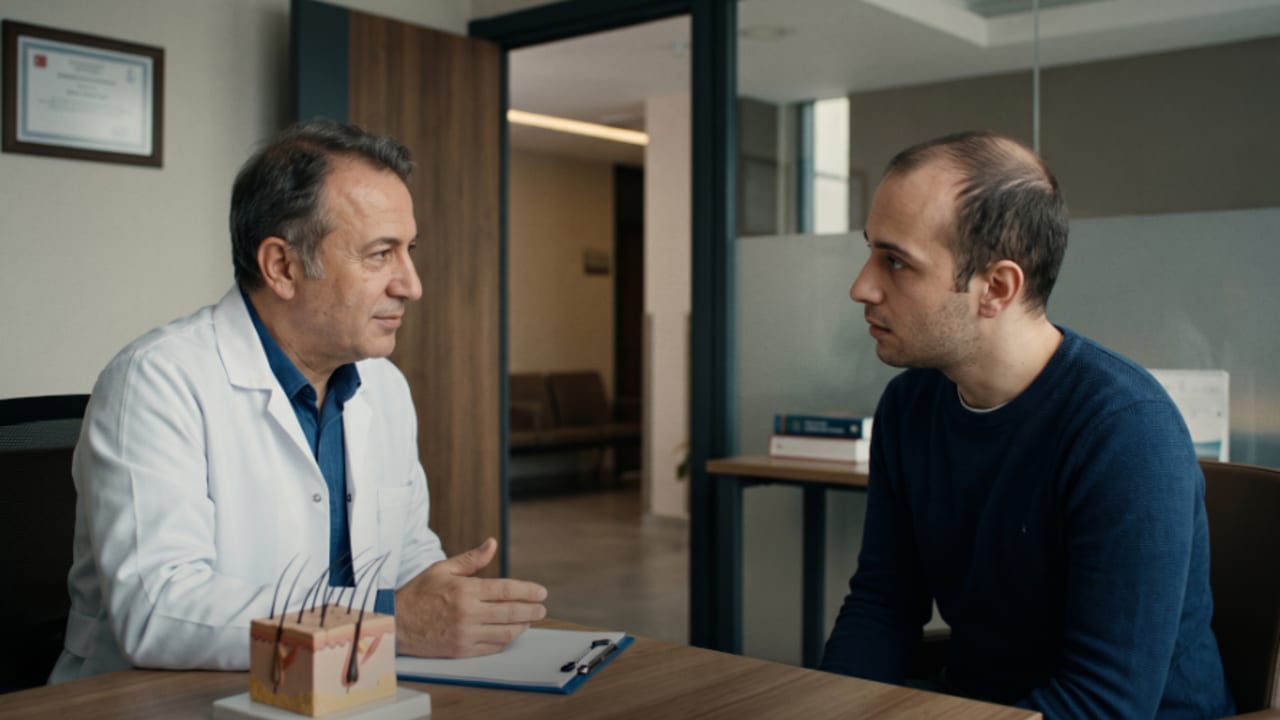
A real screening process checks a patient's health history and donor supply before any date is booked. At first contact, a patient submits photos alongside a health history form covering medication use, existing conditions, and family history. A doctor, not a sales rep, should be the one reviewing both before any quote is given. Once the patient arrives in Turkey, that same information needs checking in the face-to-face consultation through bloodwork and trichoscopic analysis. That in-person visit is also where a photo's limits show up: Whether the hair loss pattern is suitable for a transplant at all, and donor density measured rather than estimated by eye.
What happens if a clinic skips your health screening?
The cost lands on the patient, not the clinic. Missing an active scarring condition or an unmanaged bleeding risk before surgery can matter more than any part of the technique itself, and skipping this step is one of the clearest signs of a hair mill. A few signs are worth watching for before booking anything:
- A quote decided from photos alone, with no health history asked
- No questions about medications before you book
- Autoimmune or other causes of hair loss aren't separated from ordinary pattern baldness
- Donor density is estimated from photos rather than measured
- Once a deposit is paid, acceptance is automatic
Any one of these signs is worth second-guessing. Together, they mean the clinic never actually checked whether you were a safe candidate for surgery in the first place. At Vera Clinic, a hair transplant hospital in Istanbul approved by the Turkish Health Ministry, who gets accepted is a doctor's decision from the start. Donor and recipient density are mapped with AI-assisted trichoscopy, not a visual estimate.
"When a patient's health history includes usage of blood thinners, a controlled autoimmune condition, or diabetes, we don't apply a blanket rule," said Dr. Emin Gül, a hair transplant doctor at the clinic. "I review the bloodwork and the history myself, and if there's any ambiguity, I coordinate directly with the patient's own doctor before we decide. Turning a patient away isn't a failure of the consultation. It's the consultation doing what it's supposed to do."
According to Vera Clinic's internal case data, 24% of evaluations involving an existing health condition, covering diabetes, hypertension, autoimmune conditions, and cardiovascular history, end in a decline because an active condition may affect the patient's safety. Being a candidate for a hair transplant depends on that assessment, not on what a photo suggests.
The screening doesn’t stop at acceptance
Being accepted is not the end of the checking. Andrew M., who had surgery in Istanbul this year, takes low-dose aspirin for a heart condition. "I've been on aspirin for years, low dose, heart thing," he said. "I figured I'd just be told to stop it a week before and that would be that. But they picked it up in the bloodwork and actually called my cardiologist back home. The two of them worked it out between themselves. Turned out I didn't need to come off it at all. I wasn't expecting that level of back and forth over one pill."
Decisions like that are made case by case, in coordination with the doctor who prescribed the medication. Andrew's case ended in a yes. Roughly one in four of those evaluations ends the other way.
Why the right clinic might say 'no'
A clinic that screens properly can answer specific questions, not just offer reassurance. Ask who reviews your photos and health history. Ask whether your medications come up before a quote is given or only after you land. Ask what happens if something in your health history gets flagged.
The answers tell you which kind of clinic you are dealing with, in Turkey or anywhere else. A clinic that can name the doctor, the test, and the protocol is one that can also afford to turn you down. Whether you are a candidate for a hair transplant is a medical question, not a booking one. A hair transplant is surgery, and sometimes the most useful thing a clinic can tell you is that you are not ready for it yet.