
Following reports yesterday that Israel had not received a draft of the Memorandum of Understanding (MoU) between the United States and Iran, US President Donald Trump announced that he had sent it to Israel during his press conference at the end of the G7 summit on Wednesday.
He also suggested that sanctions on Iran would be removed once "they behave."
"As far as sanctions are concerned, at some point, you know, we have sanctions which will never let them rebuild. They would have no money, they would be in poverty, the 91 million people would starve, so something will happen as soon as they behave. When they behave, we're going to let that go. We're going to have to. I put sanctions on a lot of people, and then I let them go," Trump told reporters.
Frozen funds could be returned, he stated.
"We have taken their money, it's not our money, it's their money, and we froze it. At a certain point in time, I guess we're going to have to give it back," Trump said. "If we didn't give it back, nobody would ever invest in the dollar again."
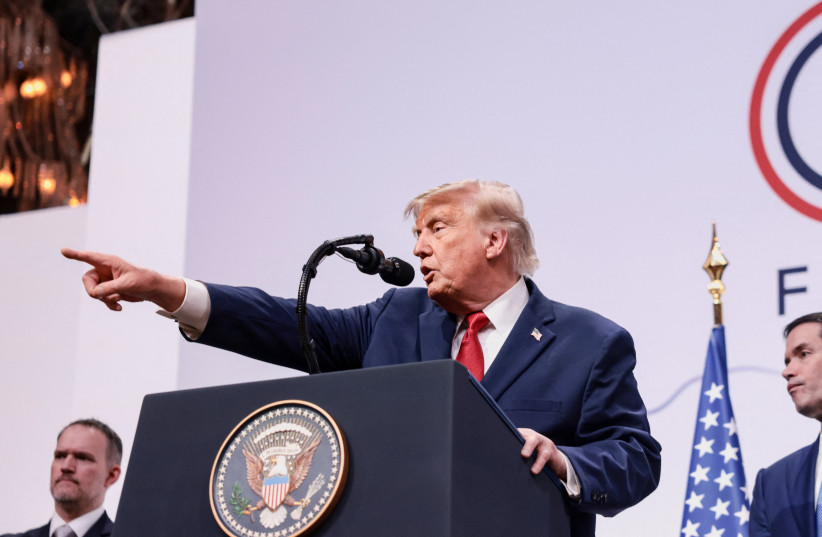
Trump added later on Wednesday, upon arriving in Paris from the G7 meeting, that the MoU could be signed by Friday.
"Over the next, I'd say, 48 hours," said Trump about the expected timeframe of the signature when asked by reporters on his way to Paris.
Reports of $300 billion US fund are false, Trump claims
Earlier, Trump said that reports of a $300 billion fund slated for Iran are false in comments to the press on the sidelines of the G7 summit.
"We're not putting up 10 cents. People can decide to do that, but that is up to them," he said.
"We are not investing in it, and we do not have a fund," he said, "That's a false story that got picked up incorrectly."
Trump added that he was not asking Gulf States to invest in Iran as well.
"We have a deal that's a fair deal. It's a good deal. We are not investing any money in Iran by the way, and that rumor got out there yesterday was ridiculous," he said, adding that he would talk about this matter later.
This comes after reports that a $300 billion private fund designed to spur investment in Iran was outlined in the MoU, and that more than half of that sum has already been committed.
A source with direct knowledge of the deal told Reuters that the fund is designed to give both sides an economic incentive to conclude a final deal to end the war.
The new fund is a private investment vehicle, not a reconstruction or reparations program, and will not include any government money or grants, the source said, adding that companies based in the US, the Gulf Arab states, Asia, South America, and Africa have agreed to commit financing.
Trump says will discuss with Gulf nations Iran's ballistic missiles, terrorist proxies
Trump told reporters at the G7 meeting in France that the United States, in a parallel effort to the US-Iran deal, will discuss Iran's ballistic missiles and terrorist proxies with Gulf nations.
At the press conference, Trump said that Syria's leader would like to target Hezbollah, the Iranian proxy group, with "precision" inside Lebanon.
The president also said that Lebanon's leader is expected to visit Washington in the coming weeks.
He later said that it would be unfair for Iran not to have ballistic missiles if other countries have them.
"I'm saying that if other countries have them, it's a little bit unfair for them not to have some," Trump told reporters in Paris.
"If Saudi Arabia and Qatar, and they all have some, I would say in relative proportion, I think it's okay."
Trump also said the United States would leave its military in the Gulf "for a while" after Washington struck a deal with Tehran to end its nearly four-month conflict in the region.
Trump touts new MoU at G7, claims he 'never cared' about regime change in Iran
Trump said that the MoU is "great for a lot of reasons, but number one, by far... is that Iran will never have a nuclear weapon."
"If they do, all hell will rain down on them, and they're not going to do that," he added.
Trump also discussed regime change, claiming that he "never cared" about it.
"I guess you have regime change because... the first group, they're all dead, the second group, they're dead, and part of the third group is gone," he added.
"We're dealing with people that I think are very rational people. I mean, they were nice to deal with... I think actually they're smarter than the first and second group, but they're not radicalized, and they're looking to help their country," he continued.
"I've watched regime changes for years - they never work," he stated.

Will US-Iran deal survive a potential IDF strike on Beirut?
Trump asserted that the MoU would survive should Israel strike in Lebanon.
"I consider that the minor war that Iran's a big one, but we have that little pin prick out there that constantly rears its head, and that's Hezbollah," he said.
"I'll tell you what, Israel's fighting Hezbollah too long, and too many people are being killed. You don't have to knock down an apartment house every time you're looking for somebody, because there are a lot of people in those apartment houses, and they're not all Hezbollah.
"I suggested to Israel to let Syria take care of Hezbollah because, to be honest with you, I think they'd do a better job of doing it. If Israel can't do the job without killing everyone else, it'll do the job. Syria will do the job."
He noted that he had spoken to Israeli leaders about strikes on Beirut, and that he "didn't like" that the IDF bombed Beirut hours before the agreement was signed.
Later, Trump said that he and Prime Minister Benjamin Netanyahu had had a "small disagreement" about Lebanon.
"I say it's possible to act a little more moderately. Maybe you don't need to bring down a building every time a Hezbollah member walks into it," he said.
Trump also called Netanyahu "a good man" who sometimes "gets a little too enthusiastic."
Trump noted that the MoU was not final, and that he could resume a bombing campaign if he did not like it.
"If I don't like it, we'll go back to shooting at them, dropping bombs on their head. If I don't like it, if they don't behave, we'll go right back to dropping bombs right smack in the middle of their head."
"We have our deal done with Iran, and it should be successful. It goes to the second stage, which I think will actually be easier," Trump added.
Trump also compared his current pending MoU to then-president Barack Obama's Joint Comprehensive Plan of Action (JCPOA), signed in 2015.
"Obama handed [Iran] $1.7b. In cash... they tried to bribe their way out of it, and you know what the Iranians did? They laughed at Obama, and they said he's a stupid son of a b****," Trump said.
Trump then thanked Qatari Emir Tamim bin Hamad Al Thani for his assistance in negotiating a deal.
"Working with Qatar and the people of Qatar was really a pleasure. They were tough. They were strong. You know, they are the closest to Iran physically. So with other countries, I noticed I had to travel about 45 minutes to get there. With you, you could walk right across the border," he said.
So you were in a more dangerous position. But I just have to say to you, uh, you fought, and you helped us, and with great bravery. So I just want to compliment you on that, and uh, you'll always be my friend."