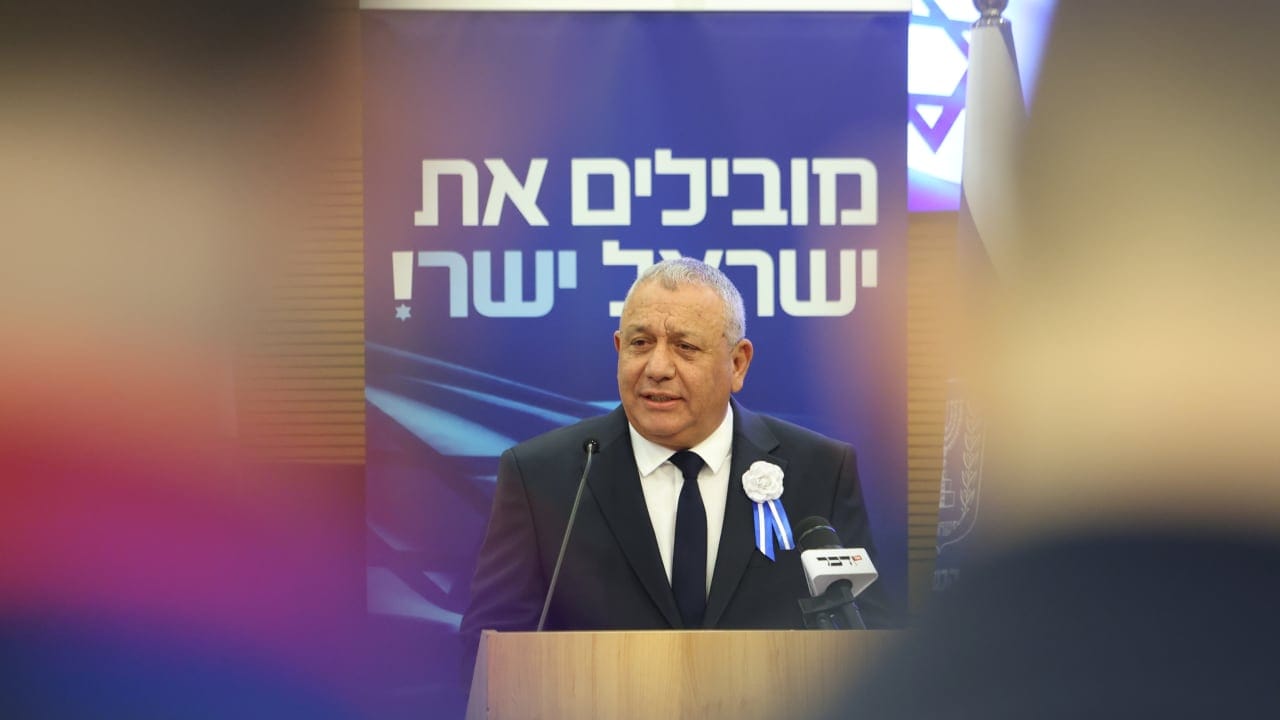
Prime Minister Benjamin Netanyahu has been exhibiting significant anxiety over the possibility of Yashar party leader Gadi Eisenkot replacing him as prime minister, former Netanyahu adviser Nir Hefetz said during a 103FM radio interview on Tuesday.
“Panic is a major factor in his decision-making,” Hefetz said. “I could almost close my eyes and see that atmosphere of panic.”
Hefetz describes panic inside Netanyahu's office
Describing the mood in the Prime Minister’s Office, Hefetz said that urgent phone calls from Netanyahu’s wife, Sara, and son, Yair, were a constant feature during periods of political uncertainty.
“Urgent phone calls every five seconds,” he said, referring to the way in which people surrounding Netanyahu are likely reacting to the developing situation.
Some of these individuals, according to Hefetz, likely include “Qatar’s representatives in the office or people like [Knesset Speaker] Amir Ohana.”

“If you were a fly on the wall, you would see the panic with your own eyes,” Hefetz continued. “This is not unusual for Netanyahu when his personal standing is at risk. It is a regular feature of how he operates when it comes to himself.”
Discussing the possibility of Netanyahu losing power, Hefetz estimated that the transition to opposition would be particularly difficult for the prime minister and his family.
“Life at home would not be easy for him, to put it mildly. And don’t forget, he is someone who loves the respect he receives from world leaders,” Hefetz said.
“Will he sit in the opposition? Will he sit aside and watch Eisenkot with the motorcade, being taken everywhere by helicopter and flying on the Wing of Zion?” he wondered, referencing Israel’s official state aircraft.
“That triumvirate – Netanyahu, Sara, and Yair – would simply explode. For them, it would be worse than people being abducted to Gaza,” Hefetz claimed.
Netanyahu could offer concessions to Eisenkot to secure unity government
Addressing Netanyahu’s call for a national unity government, Hefetz suggested that the prime minister could become increasingly unwilling to compromise as Eisenkot advances toward forming a coalition.
“The closer Eisenkot gets to forming a government, the less Netanyahu will be willing to settle for,” Hefetz said, suggesting that Netanyahu could offer further concessions instead to prevent Eisenkot from taking office.
Hefetz said that Netanyahu’s broader objective may be to prevent the dismantling of his longstanding political alliance with the haredi (ultra-Orthodox) parties.
“When you take the Arab parties out of the equation, neither bloc can ever have a majority unless the ultra-Orthodox parties choose a side,” he said. “That is what has kept him securely in power since 2015, which is why his first move was to take the Arab parties out of the game.”
Hefetz suggested that opening coalition negotiations with Eisenkot could itself serve Netanyahu’s interests by slowing the process of forming an alternative government.
“The moment Eisenkot enters negotiations with him over a unity government, it becomes less urgent. But first, he needs to stop the snowball,” Hefetz said.
He added that negotiations could include political incentives, such as legislation modeled on the so-called “French law” that would provide legal protections for an alternate prime minister.
Eisenkot poses different political challenge than Bennett, Hefetz says
Comparing Eisenkot with former prime minister Naftali Bennett, Hefetz said that Netanyahu views the former IDF chief of staff as a more formidable political opponent.
“Even during the first months when Bennett was prime minister, Netanyahu was in a terrible mood,” Hefetz said. “But there is an enormous difference between Eisenkot and Bennett.”
“Netanyahu knows this very well. Eisenkot is not afraid of him, and he knows he cannot mess with Eisenkot,” Hefetz continued.
“He won’t stammer ‘Yonit, Yonit,’ and Idit Silman won’t suddenly walk out on him,” he said.
The first reference, “Yonit, Yonit,” involves a challenging interview Bennett had with prominent news anchor Yonit Levi of Channel 12, after which Netanyahu and his allies mocked the exchange.
As for the second reference by Hefetz, this had to do with Bennett’s political difficulties when Silman defected from his coalition in 2022, causing the loss of the Knesset majority.
Hefetz also cited comments by former minister Maj.-Gen. (ret.) Elazar Stern, who recalled Eisenkot saying that his experiences during the war had changed his perspective on political pressure.
“Gadi told me, ‘After everything I went through in the last war, nothing can touch me,’” Hefetz quoted Stern as saying. “And Bibi knows that.”
Hefetz added that Eisenkot’s reputation and personal credibility could also help him secure support from potential coalition partners, particularly haredi parties.
“That is also his main weapon in forming a government,” Hefetz said. “If Eisenkot, with the reputation he has, tells the ultra-Orthodox parties, ‘You have my word that this is what will happen, and it will stay in this room,’ they can rely on that.”
Hefetz suggests Liberman received assurances from Eisenkot
Hefetz also addressed the political conduct of Yisrael Beytenu leader Avigdor Liberman, suggesting that his recent positions may reflect private understandings with Eisenkot.
"Do you think Liberman is behaving the way he is without having received a promise from Eisenkot?" Hefetz asked.
"If he had not received a quiet assurance from him, he would be making his life extremely difficult," he added.
Eisenkot received the mandate to form a government from President Isaac Herzog on Sunday, two days before Hefetz's remarks, following the October 27 Knesset election. His efforts to build a coalition have included discussions over potential cooperation with ultra-Orthodox parties, while Liberman's position remains a central factor in the negotiations.
Losing premiership could affect Netanyahu's corruption trial
Hefetz concluded by discussing the possible implications of Netanyahu losing office for his ongoing corruption trial.
He suggested that Netanyahu's status as a sitting prime minister has influenced the court's handling of his schedule and that a transition to opposition could lead judges to impose stricter attendance requirements.
"Have you considered how much his life would change?" Hefetz asked.
"The panel of judges sitting in the District Court, which allows Amit Hadad to run the proceedings, will tell him: 'You will attend every hearing.'"
"The judges will take control, and he will sit there day after day," Hefetz said.