
Prime Minister Benjamin Netanyahu responded on Friday to comments made by former US president Barack Obama, in which he accused Israel of taking "land off people and being "excessive," referring to Israel's treatment of the Palestinian people throughout the country's history.
Obama made the comments during a visit to Belfast, Northern Ireland, on Tuesday.
"The Jewish people are not foreign occupiers in the land of our forefathers," Netanyahu said in a video posted to X/Twitter. "Our history is not a colonial enterprise. Our land is not stolen land. This is our homeland."
Netanyahu called Obama's Belfast comments a "regrettable statement," emphasizing the connection between the Jewish people and the Land of Israel, noting its biblical name, "Judea."
"That's where Jews come from," he said. "And we've been attached to it for thousands of years."
The prime minister differentiated Israel from European nations with colonial pasts, saying that the Jews in Israel are not "the Dutch in Indonesia... the Belgians in the Congo, we're Jews in Judea."
Obstacle to peace lies with Israel's, America's enemies, Netanyahu says
Regarding the path to a peace agreement, Netanyahu said that the obstacle to peace is not Israel, but rather the enemies in the region shared by Israel and the United States.
Specifically, Netanyahu noted the enemies' "refusal to recognize the Jewish people's right to a state of our own, in any boundary."
He cited chants of "Death to Israel" and "Death to America," which are common in states like Iran, a shared enemy of the US and Israel.
"We are the 'Little Satan,' you are the 'Great Satan,'" he said, referencing how such states often refer to Israel and the US, respectively, saying that both countries are "defending our common civilization."
"A peace built on illusions will crash against the rocks of Middle Eastern reality," said Netanyahu. "Israel will not gamble with its survival to accommodate those who refuse to accept the facts of history, to accept our right to exist, or who wish to appease terror.
"We certainly do not; we never will," he concluded.
Obama: Palestinians 'understandably' want their 'land back'
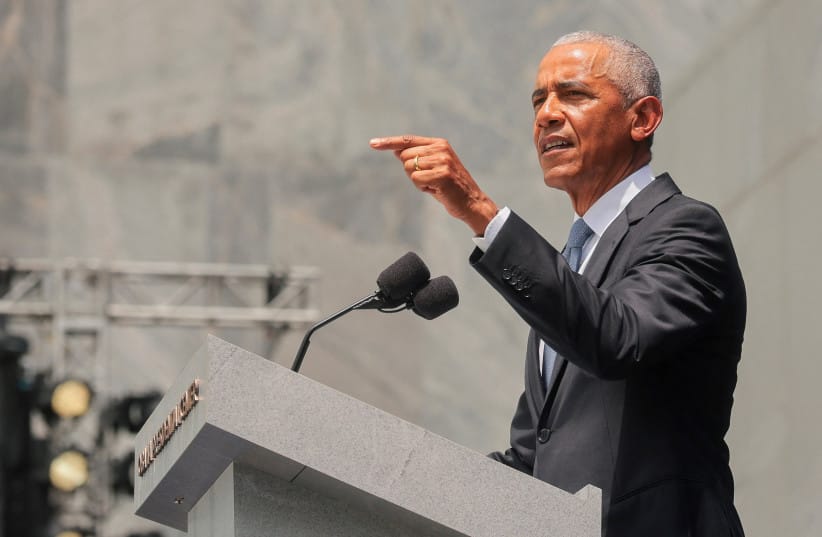
Obama's comments on Tuesday, made in a conversation with journalist Susan McKay, referred to the Palestinians' reaction to the Jewish people's exerting cultural and military control over the State of Israel by explaining that "those people understandably said, 'This is injustice, and I want my land back.'"
"The fact is that the Jewish people, for millennia, were oppressed, discriminated against, killed," said Obama at the time. "Europe was responsible for much of it. They understandably sought a refuge."
"If the attitude of Israel is, now that we are the strongest, the most technologically advanced in the region, then our security will depend on us simply doing whatever we need and taking whatever we want, and not making any concessions to anyone," he added. "That may work short-term... but you have ceded moral ground if that is the position you take."
Obama did introduce nuance into the conversation, according to The Irish Times, saying that the millions of Jews and Palestinians in the region "aren't going anywhere."
"The citizenry of Israel has to rethink, to reimagine, how your children and grandchildren are going to live in this region," he said. "Are you just going to be behind walls and wipe out everybody around you, or are you going to find some just way of defending yourself while still acting in an ethical, moral way?"
Obama added that the Palestinians must come to understand that they will not "outkill" or "outweaponize the Israelis."
"We have to look to other examples of how change comes about," he said, pointing toward "nonviolent strategies." "That's going to take some time."