
Israel’s Ambassador to the United Nations Danny Danon has brought a delegation of more than 20 countries to Israel for a tour of some of the country’s most sensitive security areas, including Gaza, the Golan Heights, and the border with Lebanon. The visit is intended to give foreign diplomats firsthand exposure to Israel’s security challenges and allow them to meet communities affected by conflict.
The timing is important because the UNIFIL mandate in Lebanon is ending, and it remains to be seen what will replace the UN forces.
Speaking to The Jerusalem Post during the delegation’s visit to northern Israel, Danon said the tour was an opportunity to show diplomats realities that are often missing from discussions at the UN. “It’s not the first delegation, but every time we learn new things.”
The ambassadors visited Gaza two days earlier, where they entered a Hamas tunnel in the area of the Yellow Line. They subsequently traveled North to see the border with Lebanon and meet Druze families in Majdal Shams on the Golan Heights.
Danon described the encounter with the Druze families as particularly emotional. He said the visit would also take the delegation to the Syrian border, where Israel continues to face security challenges.
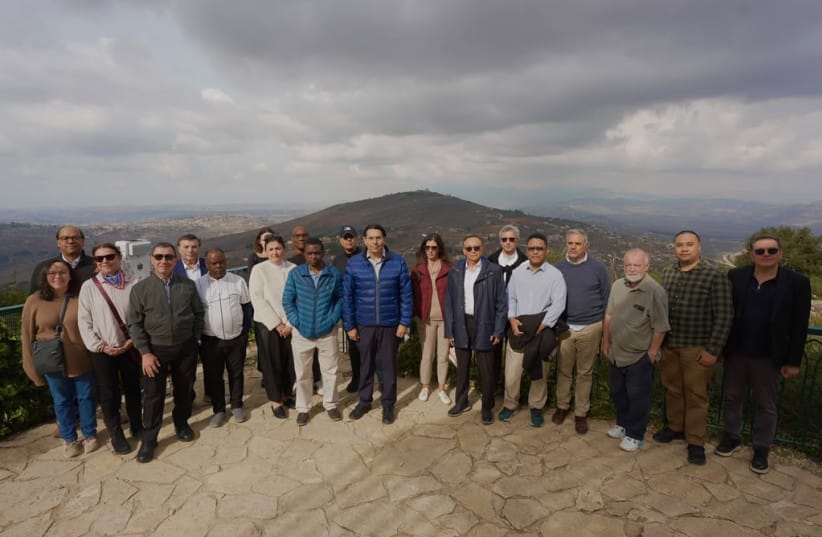
“Now we are in the North and saw the border with Lebanon; and hopefully UNIFIL forces will start moving out from their posts in 2027; and now we will go to Syria, where we have challenges,” he said.
Bringing the reality of Israel to the UN
Danon said the delegation included representatives of countries that are already friendly toward Israel, as well as diplomats who have not formed strong positions on regional issues, “those here to learn and explore.”
For many of the participants, the visit was their first trip to Israel. Danon argued that direct exposure to Israeli communities and security concerns could help counter the way Israel is frequently portrayed in international forums. “In the UN, you hear about genocide and starvation and the winter campaign against Gaza; it sounds horrible, but we must be strong, and we are peaceful.”
He said the personal relationships developed during the trip were also important, particularly because ambassadors spend several days together traveling and discussing the issues affecting their respective countries. “It’s important and effective, and you spend days with colleagues on a bus, and you learn about their concerns and their countries.”
The delegation also visited Poland before coming to Israel. This included a visit to Auschwitz and Krakow. Germany’s ambassador joined the Polish portion of the trip, which Danon described as emotional.
One participant Danon highlighted was Ambassador and Permanent Representative of Trinidad and Tobago to the United Nations in New York Neil Parsan. Although the Caribbean country may be unfamiliar to many Israelis, Danon noted that its representative would be involved in Security Council discussions concerning Lebanon, Syria and Gaza. This is because Trinidad and Tobago was recently elected as one of the non-permanent members of the UN Security Council.
“For him to be here and see the proximity to Lebanon of the border villages and the instability in Syria and disarmament...” The Israeli ambassador said these experiences could help diplomats understand the geography and security concerns behind issues that are frequently debated at the UN.
Lebanon and the future of UNIFIL
The delegation’s visit to the Lebanese border comes as discussions continue over the future of the United Nations Interim Force in Lebanon (UNIFIL). Danon said Israel wants the Lebanese Armed Forces (LAF) to assume responsibility for security along the border as the international mission approaches the end of its mandate.
“We want to see the Lebanese military, period. We want to see Lebanese soldiers.” He compared the desired arrangement to Israel’s borders with Egypt and Jordan, where the neighboring countries’ national armed forces are responsible for security. Danon said Israel was coordinating with Washington over arrangements following UNIFIL’s departure and was seeking to maintain quiet in southern Lebanon.
“The mandate is over at end of year, there are discussions about [the] “day after” and we coordinate with the US.”
Danon also addressed the delegation’s visit to northern Israel in a post on X/Twitter on Tuesday, highlighting Hezbollah’s military capabilities and criticizing UNIFIL’s record in southern Lebanon.
“Today, we toured Israel’s northern border with a delegation of UN ambassadors. We showed the ambassadors the threats from Lebanon and Syria, focusing on Hezbollah’s attempts to rearm and upgrade its drone and UAV capabilities. UNIFIL has failed to enforce Resolution 1701 and prevent Hezbollah’s military buildup. Israel will not entrust the security of its citizens to ‘international forces.’ We trust only the soldiers of the IDF.”
Danon emphasizes Israel does not want international interference
The statement underscored Danon’s position that Israel cannot depend on international peacekeepers to prevent Hezbollah from rebuilding its military capabilities. UN Security Council Resolution 1701, adopted in 2006, calls for security arrangements in southern Lebanon that prevent the presence of unauthorized armed groups.
The issue is particularly relevant to diplomats who will be involved in future Security Council discussions about Lebanon and the role of international peacekeeping forces. In Gaza, the ambassadors were shown a Hamas tunnel and briefed on the security and humanitarian situation. Danon said the visit illustrated why Israel considers the disarmament of Hamas essential to any lasting reconstruction or political arrangement in Gaza.
“Nothing will happen as long as Hamas is in power; they saw the security challenges and humanitarian... we provide aid trucks, but as long as Hamas is there, nothing will happen.”
The ambassador emphasized that the delegation was intended to expose diplomats to multiple aspects of Israeli society, rather than focusing exclusively on military and security matters.
He said participants also had opportunities to encounter Israeli culture and civil society before returning to their countries and their work at the United Nations. For Danon, the objective of the visit was to ensure that ambassadors who participate in debates at the UN have personally visited the communities, borders, and security areas at the center of the discussions.