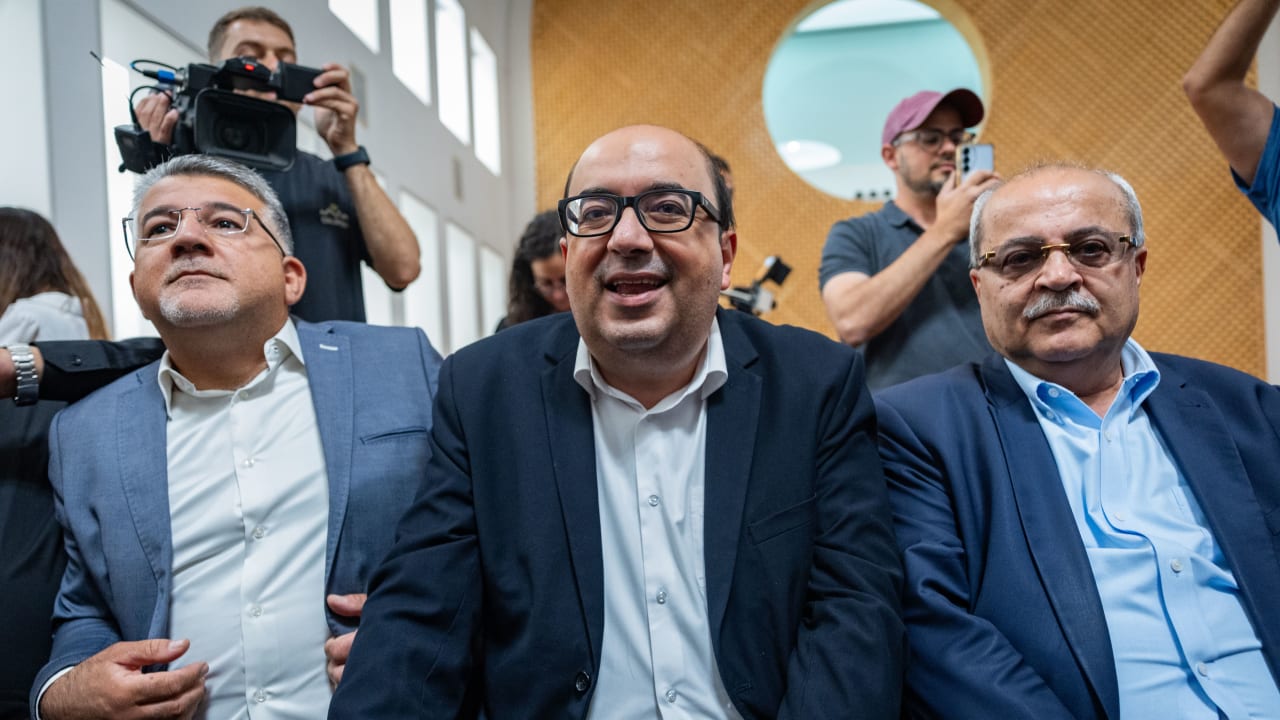
A majority of the Supreme Court’s nine-justice panel appeared prepared on Thursday to approve the disqualification of Balad chairman Sami Abu Shehadeh from the October 27 election, while all nine justices urged him to withdraw his candidacy before they rule.
The court convened Thursday to consider four election-disqualification cases. The Central Elections Committee voted last week to bar Abu Shehadeh and MK Ofer Cassif and to exclude Ra’am and the Joint List. The decisions against the lists were appealed, while the individual cases reached the Supreme Court automatically, because disqualifying a candidate requires its approval.
Supreme Court President Isaac Amit said the justices were unanimous that Abu Shehadeh’s statements were “painful, outrageous and repugnant,” but added that there were differing views on the legal result.
After the judges consulted during a break, Amit said, an emerging majority appeared to favor approving the disqualification. All nine nevertheless joined the recommendation that Abu Shehadeh consider withdrawing, which would remove the need for a reasoned judgment in his case. The court gave him until 8 a.m. Friday to respond.
If he remains in the race, the Supreme Court must issue its decision by Sunday.
Amit announced after the court had concluded the hearing on Abu Shehadeh’s candidacy and began hearing the case against MK Ofer Cassif. National Security Minister Itamar Ben-Gvir opposed the recommendation and argued that the court should issue a ruling rather than allow Abu Shehadeh to withdraw voluntarily.
The Joint List called the recommendation “disqualification in practice” and urged Arab voters to respond with mass turnout.
All four cases arise under Section 7A of Basic Law: The Knesset, which allows disqualification for negating Israel’s existence as a Jewish and democratic state, inciting racism, or supporting armed struggle against Israel. Supreme Court precedent reserves the measure for extreme cases supported by clear, convincing, and unequivocal evidence of a central and dominant objective.
The panel consisted of Amit and Justices Dafna Barak-Erez, Yael Willner, Alex Stein, Khaled Kabub, David Mintz, Ofer Grosskopf, Gila Canfy-Steinitz and Yechiel Kasher.
Case heard by nine-justice panel as protesters gather against Ben-Gvir
Dozens of protesters gathered outside in support of the Arab lists and candidates. Some confronted Ben-Gvir, who called them “terror supporters.”
The committee’s final vote to disqualify Abu Shehadeh was 31-four, after its chairman, Supreme Court Deputy President Noam Sohlberg, took the unusual step of voting in favor. Attorney-General Gali Baharav-Miara and State Attorney Amit Aisman asked the court to approve the decision only on the armed-struggle ground.
Their position focused primarily on an article Abu Shehadeh published on October 8, 2023, while the Hamas attack was still unfolding. It described the attack as an event of military, political and strategic significance and discussed its potential political “fruits.”
Barak-Erez asked how the court should reconcile what she described as “objectively a horrific article” with the much stronger evidence ordinarily required to bar a candidate, and what weight should be given to Abu Shehadeh’s roughly 30 years of public activity.
The Attorney-General’s representative said an exceptional case could be decided on a single item of “golden evidence,” while acknowledging that the other material might not meet the threshold individually.
Grosskopf asked whether any action had been taken when the article appeared. The state said authorities had not known about it at the time.
Representing Abu Shehadeh, Hassan Jabareen of the Adalah Legal Center argued that one article did not constitute the required “critical mass” of evidence when weighed against his client’s nonviolent political record.
Stein and Kasher questioned whether an article written spontaneously at such a critical moment revealed Abu Shehadeh’s genuine position more clearly than his later explanations.
Abu Shehadeh said he had intended one of the article’s most disputed passages, about what “small, besieged Gaza” had achieved, as a warning that Israel needed to reassess its policies and vulnerabilities. He acknowledged that the passage had not conveyed that meaning and said he opposed the attack when he wrote it.
“The article contains things that were wrong,” he said. “I would not say them today, and I should not have written it that way.”
Canfy-Steinitz asked why he had not removed the article or published a condemnation once the scale of the attack became clear. Abu Shehadeh said it had been an intensely pressured period, that he had forgotten about the article and that he regretted publishing it.
“Is this truly enough to bar him from running?” Jabareen asked. “Is he really the most extreme parliamentarian?”
Abu Shehadeh concluded by telling the court that his political work was directed toward “freedom, equality and peace for everyone.”
“I have never called for violence, and I never will,” he said. “I am against it. Those are not my tools.”
CEC votes to bar MK Cassif, Ra'am, Joint List
The committee voted 19-five, with two abstentions, to bar Cassif on the grounds of negating Israel as a Jewish and democratic state and supporting armed struggle.
Likud attorney Ilan Bombach argued that Cassif’s accusations that Israel had committed genocide, support for international proceedings and sanctions, calls for boycotts and statements about Palestinian resistance formed a sustained pattern that crossed the statutory line.
The justices repeatedly pressed Bombach to connect the statements directly to a statutory ground. Willner asked whether calling for a boycott, without more, demonstrated support for terrorism or negation of Israel as a Jewish and democratic state.
The Attorney-General opposed Cassif’s disqualification. Her representative said his statements did not form the required “critical mass,” and that supporting the release of Palestinian security prisoners was not itself support for their acts.
Cassif said the application used incomplete quotations and that, while one cited statement discussed a claimed right to armed resistance, he had expressly said he opposed violence and supported nonviolent struggle.
The committee voted 18-five, with one abstention, to disqualify the Joint List. The list argued that the application relied largely on material previously considered and rejected, and on an outdated Balad platform rather than the current alliance’s platform, candidates and activities.
The judges challenged Likud after Bombach said Arab citizens could vote for Likud or another Zionist slate rather than an Arab party.
Grosskopf asked whether Likud was proposing that Arab representatives could enter the Knesset only through Jewish parties. When Bombach noted that Arab parties could become part of a government, Grosskopf asked whether that possibility was itself a reason to exclude them.
“I think the cat is out of the bag,” Amit said.
The Joint List said its goals included fighting crime, advancing equality and public investment, and supporting a Palestinian state alongside Israel. Baharav-Miara opposed its disqualification.
The committee also voted 18-five, with one abstention, to disqualify Ra’am. Applications filed by Otzma Yehudit, Likud and the Choosing Life Forum sought to link it to the southern branch of the Islamic Movement, Aid 48 and other associations accused of aiding Hamas-linked entities.
Adalah attorney Suhad Bishara said Ra’am had operated in the political arena since 1996 and had joined the Bennett-Lapid coalition. She called the applications politically motivated and an attempt to create a legal rule “out of nothing.”
The judges pressed her to answer the factual allegations surrounding the charities directly. Bishara said Ra’am denied any organizational or financial affiliation with Aid 48 and that the associations in question operated legally.
Jabareen said none of the cited employees had a relevant criminal record and that the associations, the Attorney-General and Shin Bet, had found no such connection.
The Attorney-General’s representative, Anat Goldstein, said similar applications had previously been rejected and that authorities had examined the new material without finding evidence connecting Ra’am itself to the associations’ alleged conduct.
“It was not proven that one of Ra’am’s goals, certainly not a dominant goal, is support for armed struggle against Israel,” Goldstein told the court.
Otzma Yehudit attorney Ze’ev Wolf argued that Ra’am chairman Mansour Abbas had refused to call Hamas a terrorist organization and described former police major-general Yoav Segalovich, who recently joined the Ra’am slate, as a “fig leaf.”
Willner stressed that the case concerned the party, its platform and its purposes. Kabub asked whether Abbas’s failure to use the requested terminology showed that he supported Hamas, while Barak-Erez said the relevant inquiry was what a person had affirmatively supported.
The court concluded the hearings Thursday evening. Its decisions on Cassif, the Joint List and Ra’am are expected by Sunday.