
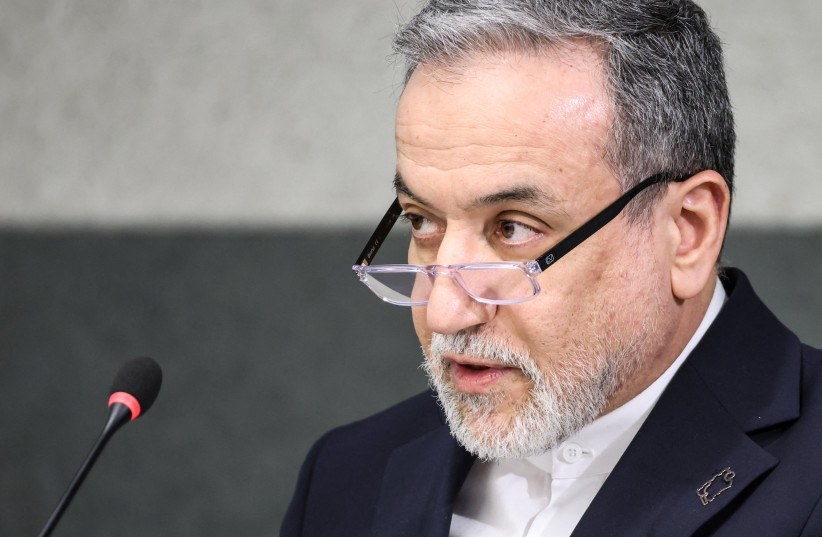
The son of an Iranian carpet merchant from Isfahan, Foreign Minister Abbas Araghchi, who will accompany the parliament speaker in peace talks with the United States in Pakistan, has compared the country's negotiating style to the bartering of the bazaar, an approach requiring "patience and great time."
Iranian and US officials are expected to hold talks on Friday to discuss a long-term settlement after the longtime foes agreed on a Pakistan-brokered two-week ceasefire to suspend a six-week-old war that has killed thousands, spread across the Middle East, and caused unprecedented disruption to the world's energy supplies.
Tehran said the Iranian delegation, led by influential former commander of Iran's Revolutionary Guard Corps, Mohammad Bagher Ghalibaf, will enter peace talks with caution, citing a deep trust deficit with Washington.
Israel removed Araghchi and Ghalibaf from its hit list after Pakistan urged Washington to press Israel not to target them, a Pakistani source told Reuters last month, making them some of the few top figures left that could negotiate with the United States after scores of Iran's senior political and military officials were targeted during the war.
Araghchi, Iran's top diplomat since 2024, was picked by Iran's late Supreme Leader Ayatollah Ali Khamenei to lead several rounds of talks with US Middle East envoy Steve Witkoff, in efforts to resolve Tehran's longstanding nuclear dispute with the West.
Talks, mediated by Oman, stalled on core issues, from uranium enrichment to missiles and sanctions relief.
The mild-mannered diplomat played a key role in years of negotiations that led to Tehran's 2015 nuclear deal with world powers - the agreement torn up by Trump in 2018 during his first term.
Political insiders have described the British-educated Araghchi as one of the Islamic Republic's most powerful foreign ministers yet.
Iran's clerical establishment appears confident in his ability to play its hand with deftness and guile.
Writing in his 2024 book The Power of Negotiation, Araghchi noted that the Iranians' negotiating approach was commonly referred to as "the style of the bazaar," meaning "continuous and persistent bargaining." He described in a footnote memories of his late mother's bartering skill.
But he also cautioned against overplaying your hand. "When you sell snow under the sun, bargaining more than necessary is a loss," he wrote, in an Arabic translation of the book.
Araghchi seen as master of tough negotiations
Araghchi cultivated a reputation as a master of tough negotiation during the talks over Iran's nuclear program over a decade ago. Under that deal, Iran agreed tight restrictions on its nuclear program in exchange for sanctions relief.
Western diplomats involved in those talks have described him as serious, technically knowledgeable, and straightforward.
Araghchi joined Iran's 1979 Islamic Revolution as a teenager and fought in the 1980s Iran-Iraq War before embarking on a diplomatic career.
An insider who has known Araghchi for years said he is calm and patient, yet combative and resilient.
Araghchi was the point man for ultimately unsuccessful efforts to resurrect the 2015 deal during US President Joe Biden's 2021-25 administration, until he was replaced with a hardliner.
Soon afterwards, he was named secretary of Iran's Strategic Council on Foreign Relations - a key body advising the supreme leader, pulling him into the inner orbit of Iran's ultimate authority.
Born in Tehran in 1962 to a wealthy religious merchant family, Araghchi was only 17 when the Islamic Revolution washed over Iran and filled many of its youth with radical fervor.
Inspired by the ousting of the US-backed Shah's dynastic regime and the promise of a new future, he enlisted in the Islamic Revolutionary Guard Corps, Iran's military vanguard, to fight in the 1980-88 war with Iraq.
He joined the foreign ministry in 1989 and served as ambassador in Finland from 1999 to 2003 and Japan from 2007 to 2011 before becoming foreign ministry spokesman in 2013.
He obtained a doctorate in politics from the University of Kent in Britain and was appointed deputy foreign minister in 2013.
A devout Muslim, Araghchi has served under presidents whose instincts have ranged from pragmatic to hardline.
Despite being a political insider with close ties to Khamenei, Araghchi has kept himself distant from "political frays and infighting" between factions and he maintained good relations with the powerful Revolutionary Guards and all factions in Iran, according to a senior Iranian official.